
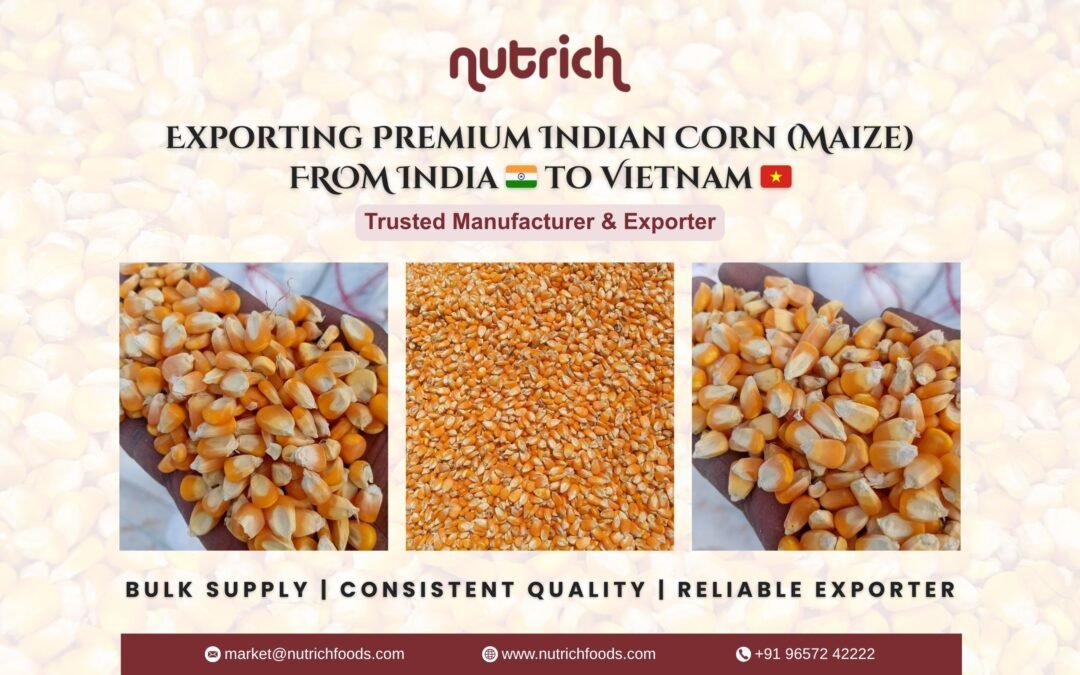
Nutrich Foods is a trusted Indian corn (maize) supplier to Vietnam, delivering consistent bulk export shipments from India to leading processors and industrial buyers. As a reliable maize exporter from India to Vietnam, we focus on uniform grain quality, controlled moisture, and dependable shipment execution.
In today’s competitive global trade, buyers do not just look for maize availability. They look for a consistent maize supplier from India who can deliver the same quality across every shipment, maintain export standards, and support long-term sourcing.
India to Vietnam Maize Trade: Demand, Growth & Market Insights
Maize Demand in Vietnam
Vietnam’s demand for maize continues to rise at a steady pace. The country depends on imported maize to support its growing processing and industrial sectors. Domestic production cannot fully meet this demand, so import volumes increase every year.
Today, buyers in Vietnam focus on more than just availability. They look for consistent quality, stable supply, and dependable exporters. As competition grows, only suppliers who maintain uniform shipments and clear communication succeed in building long-term relationships.
Why Vietnam Imports Maize from India
Vietnamese buyers choose India as a sourcing origin for several practical reasons. First, India offers competitive export pricing, which helps buyers manage procurement costs. Second, exporters provide bulk supply with flexible shipment planning, allowing better inventory control.
More importantly, Indian maize now meets improved export standards. Suppliers focus on cleaning, grading, and moisture control, which ensures better performance during processing. Because of this, buyers increasingly trust Indian exporters for repeat shipments.
Maize Trade India–Vietnam Overview
Trade between India and Vietnam has grown consistently over the past few years. Indian exporters handle bulk shipments with structured processes and reliable logistics support.
Each shipment typically follows a clear workflow:
- Quality inspection before dispatch
- Lab testing and documentation
- Organized loading and port handling
This systematic approach reduces risks and ensures smoother delivery. As a result, buyers in Vietnam prefer working with suppliers who can deliver consistency across multiple shipments, not just one good consignment.
Maize Global Market Trends
The global maize market continues to expand, with strong demand across Asia. Vietnam remains one of the key import-driven markets, where buyers actively compare sourcing options from India, the United States, and Brazil.
India continues to strengthen its position due to:
- Competitive pricing
- Seasonal bulk availability
- Improving export quality standards
These factors make India a reliable and practical sourcing destination for international buyers looking for long-term supply stability.
According to recent maize global market trends, Asian markets—especially Vietnam—continue to increase dependency on imports due to rising demand in feed and processing industries. This shift creates strong opportunities for Indian maize exporters to establish long-term supply partnerships with consistent quality and scalable volumes.
Why do Vietnam buyers import maize from India?
Vietnamese buyers import maize from India because it offers competitive pricing, consistent quality, and reliable bulk supply. Indian exporters also maintain better shipment flexibility and improving export standards, which support long-term sourcing requirements.
What is Maize? Understanding Corn, Quality & Export Standards
What is Maize and Difference Between Maize and Corn
Maize and corn refer to the same crop, but usage depends on geography and context. In international trade, the term maize is more common, especially in documentation and export communication. In everyday language, especially in some markets, people use the word corn.
From a commercial perspective, there is no difference in the commodity itself. However, in export business, clarity in terminology matters. Buyers, suppliers, and logistics teams usually prefer the term maize when dealing with contracts, specifications, and shipments.
What is Export Quality Maize
Export quality maize meets clearly defined physical and handling standards. It is not just about appearance—it is about consistency and compliance with buyer requirements.
A shipment that qualifies as export grade typically includes:
- Clean and well-processed grains
- Controlled moisture levels suitable for storage and transit
- Low percentage of broken kernels
- Minimal foreign matter and impurities
- Proper drying to avoid spoilage
Export quality maize must also maintain uniformity across the entire shipment. Buyers expect the same standard in every lot, not variation from bag to bag or container to container.
Yellow Corn India Export Quality
Indian yellow maize has gained strong acceptance in international markets due to visible quality and improving processing standards. Exporters focus on cleaning, grading, and drying to ensure the product meets global expectations.
Key characteristics often include:
- Bright natural yellow color
- Consistent grain size
- Low dust and impurities
- Proper post-harvest handling
These factors help Indian exporters compete effectively with other global suppliers. Buyers now recognize India as a practical sourcing option when consistency and pricing both matter.
Maize Grain Quality and Kernel Uniformity
Grain quality directly impacts how maize performs during processing. Uniform kernels ensure predictable behavior in handling, storage, and downstream operations.
When grain size varies significantly, it can create issues such as uneven processing and inefficiency. This is why exporters pay close attention to grading and sorting before dispatch.
High-quality maize typically shows:
- Uniform kernel size and structure
- Balanced hardness and dryness
- Clean surface without contamination
Consistency at this level helps buyers maintain stable operations. It also reduces losses and improves overall efficiency at the destination.
What is export quality maize?
Export quality maize refers to maize that meets strict standards for moisture control, grain uniformity, low broken percentage, and minimal foreign matter. Suppliers clean, grade, and dry maize to ensure it performs consistently during storage, transport, and industrial processing.
Maize Quality Parameters for Export to Vietnam
Maize Moisture Specification for Export
Moisture control sits at the center of export-quality maize. Exporters target a safe moisture range to protect the cargo during storage and transit. When moisture rises above acceptable levels, the risk of fungal growth, odor, and weight loss increases.
Reliable suppliers dry maize properly before dispatch and verify levels through testing. They also protect the cargo from humidity during loading and shipping. Stable moisture helps buyers store and process the material without loss.
Broken Maize Percentage and Foreign Matter
Buyers in Vietnam pay close attention to the percentage of broken kernels and the presence of foreign matter. A high broken ratio reduces usable output and affects handling efficiency. Foreign matter—such as dust, husk, stones, or other particles—creates processing issues and can lead to rejection.
Export-grade maize keeps both factors under control through effective cleaning and grading. Uniform kernels with minimal breakage support smooth operations at the destination and reduce waste during processing.
Maize Contamination Control for Export
Contamination control is critical in international trade. Exporters must ensure that maize remains free from visible impurities and biological risks. Proper post-harvest handling, clean storage conditions, and careful loading practices help maintain product integrity.
Suppliers also use protective measures during transit. They avoid moisture exposure, keep containers clean, and follow disciplined handling procedures. These steps ensure that maize reaches Vietnam in the same condition as it left the origin.
Maize Lab Report Parameters and Testing
Professional exporters support each shipment with lab reports and inspection data. These reports confirm that the material meets agreed specifications.
Typical testing parameters include:
- Moisture level
- Percentage of broken kernels
- Foreign matter content
- Grain uniformity and appearance
Pre-shipment inspection adds another layer of assurance. Buyers can review test results before dispatch, which builds confidence and reduces the risk of disputes.
Professional maize exporters in India also align their quality parameters with buyer requirements in Vietnam, ensuring that each shipment meets processing expectations. This includes consistency in grain structure, stable moisture levels, and reliable documentation support for smooth import clearance.
How to check maize quality before import?
Buyers can check maize quality by reviewing lab reports for moisture, broken percentage, and foreign matter. They should also request pre-shipment inspection, verify supplier grading and cleaning processes, and confirm that the cargo meets agreed specifications before dispatch.
Nutrich Foods: Trusted Indian Maize Supplier to Vietnam
Maize Manufacturer & Exporter in India
Nutrich Food Pvt. Ltd. operates with a clear focus on quality, process control, and export reliability. With decades of experience in the agri sector, the company has built strong capabilities in sourcing, cleaning, grading, and preparing maize for international markets.
Every shipment follows a structured workflow. The team checks raw material quality, processes it through cleaning and grading systems, and verifies specifications before dispatch. This approach ensures that buyers receive maize that matches agreed standards—without surprises at destination.
Bulk Maize Supplier for Vietnam Market
As a bulk maize supplier from India, Nutrich Foods supports buyers in Vietnam with scalable supply. The company handles large-volume requirements through organized procurement and efficient logistics planning.
Bulk shipments move with clear coordination—from loading schedules to documentation and dispatch timelines. This reduces delays and helps buyers maintain steady inventory. Whether the requirement is containerized cargo or bulk movement, the focus remains on smooth execution.
Consistent Maize Supply Across Shipments
Consistency defines long-term export relationships. Nutrich Foods maintains uniform quality across multiple shipments by controlling key parameters at every stage.
The team follows strict checks for moisture levels, grain size, and cleanliness. It avoids variation between lots and ensures repeatable quality. Buyers benefit from predictable performance, which supports stable operations at their facilities.
This consistency is not accidental. It comes from disciplined sourcing, controlled processing, and continuous monitoring before shipment.
Reliable Maize Supplier from India
Reliability goes beyond product quality. It includes communication, documentation, and timely execution. Nutrich Foods maintains clear coordination with buyers at every step—from inquiry to delivery.
The company shares specifications, confirms shipment schedules, and updates buyers during execution. It also ensures that export documentation is accurate and complete, reducing the risk of delays at destination ports.
Over time, this combination of quality, consistency, and reliability positions Nutrich Foods as a trusted partner for buyers in Vietnam looking for a dependable maize supplier from India.
As an experienced maize manufacturer and exporter in India, Nutrich Foods supports B2B buyers with bulk maize supply for Vietnam. We work closely with feed processors, industrial users, and commodity buyers who require consistent shipments without quality variation.
Our strength lies in repeatability. Buyers who source maize from India often face inconsistency between shipments. We solve this by maintaining strict control over sourcing, grading, and dispatch processes.
This makes Nutrich Foods a reliable maize supplier from India to Vietnam for long-term contracts and bulk procurement requirements.
Pricing Insights: Maize Price in India vs Vietnam
Corn Price per Ton in India
Maize prices in India change based on season, crop output, and regional supply. During peak harvest, prices tend to remain competitive due to higher availability. In lean periods, prices may firm up as supply tightens.
For export buyers, the price per ton in India often remains attractive compared to other global origins. This gives importers a cost advantage, especially when sourcing in bulk. However, serious buyers focus not only on price but also on consistency and reliability of supply.
Maize Export Price from India
Export pricing from India depends on multiple operational factors. Suppliers calculate prices based on procurement cost, processing (cleaning and grading), packaging, and logistics.
Exporters usually quote prices on:
- FOB (Free on Board) basis from Indian ports
- Bulk or container shipment terms
A well-structured exporter maintains transparency in pricing. Clear breakdowns help buyers understand what they are paying for and avoid confusion during negotiation.
Maize CIF Price in Vietnam
The CIF (Cost, Insurance, Freight) price in Vietnam includes product cost, shipping charges, and insurance. This gives buyers a complete landed cost estimate.
CIF pricing varies depending on:
- Freight rates between India and Vietnam
- Port of loading and discharge
- Shipment size and container availability
Buyers often compare CIF quotes from multiple suppliers. However, the lowest price does not always guarantee the best value. Reliable supply and consistent quality reduce hidden costs in the long run.
Factors Affecting Maize Pricing
Maize pricing is dynamic and influenced by several factors across the supply chain. Key elements include:
- Seasonality and crop yield in India
- Global demand and market trends
- Logistics and freight costs
- Quality specifications (moisture, cleanliness, grading)
- Currency fluctuations and trade conditions
Smart buyers evaluate all these factors together. They do not rely only on the lowest quote. Instead, they choose suppliers who can deliver stable pricing, consistent quality, and reliable execution across shipments.
Buyers in Vietnam often compare maize FOB price India and maize CIF Vietnam price before finalizing suppliers. While pricing remains important, experienced importers prioritize consistent supply and quality stability over short-term cost advantages.
This balanced approach helps importers in Vietnam secure better long-term value, rather than short-term cost savings that may lead to operational issues later.
Handling, Storage & Logistics for Maize Export
Maize Storage Conditions
Proper storage starts immediately after processing. Export-grade maize must stay dry, clean, and well-ventilated at all times. Suppliers store maize in covered warehouses with controlled conditions to prevent moisture absorption and contamination.
Stacks remain elevated from the floor. Airflow is maintained to avoid heat build-up. Regular inspection helps detect any early signs of spoilage. These practices ensure that maize retains its quality before loading and dispatch.
Maize Moisture Control During Transit
Moisture remains the biggest risk during shipment. Even well-dried maize can absorb humidity if not handled correctly. Exporters take preventive steps at every stage of transit.
They use dry and clean containers. They check container condition before loading. In many cases, they use liners or moisture-absorbing materials to reduce humidity exposure. Proper sealing of containers further protects the cargo.
Consistent moisture control ensures that maize reaches Vietnam in the same condition as it left the origin. This reduces rejection risk and protects buyer operations.
Maize Packaging Options for Export
Exporters offer different packaging formats based on buyer requirements and shipment type. Common options include:
- PP bags (25 kg / 50 kg) for easier handling and distribution
- Jumbo bags (bulk bags) for larger volume efficiency
- Loose bulk loading for high-volume shipments
Each option serves a specific purpose. Bagged shipments provide flexibility at the destination, while bulk loading reduces packaging cost and speeds up loading operations.
The right packaging choice depends on handling infrastructure, storage capacity, and buyer preference.
Bulk Maize Shipment vs Container Shipment
Buyers choose between bulk and container shipments based on volume and logistics planning.
Bulk shipments suit large-volume buyers. They reduce packaging costs and allow faster loading. However, they require proper unloading infrastructure at the destination.
Container shipments offer more control and flexibility. They protect cargo better and suit medium-sized orders. Containers also simplify handling and reduce exposure during transit.
Both methods work effectively when planned correctly. The key lies in matching the shipment type with buyer requirements, infrastructure, and delivery timelines.
Efficient maize logistics from India to Vietnam also depends on proper coordination between suppliers, freight partners, and port operations. Timely loading, accurate documentation, and shipment tracking help buyers avoid delays and maintain production schedules.
Why Choose India for Maize Supply?
Maize India vs USA vs Brazil
Global buyers often compare sourcing options across India, the United States, and Brazil. Each origin has its strengths, but India offers a balanced combination of pricing, availability, and improving quality standards.
The United States supplies large volumes with established infrastructure. Brazil offers competitive pricing during certain seasons. However, India provides a practical middle ground. Buyers benefit from steady availability, flexible shipment planning, and consistent quality improvements.
For Vietnam-based importers, sourcing from India often means shorter decision cycles and smoother coordination with exporters.
Competitive Pricing from India
One of the key reasons buyers choose India is pricing efficiency. Indian suppliers offer competitive rates due to strong domestic production and lower operational costs compared to some global markets.
Exporters also provide flexibility in pricing structures, whether on FOB or CIF terms. This allows buyers to plan procurement based on budget and logistics preferences.
More importantly, competitive pricing from India does not come at the cost of quality. Suppliers focus on maintaining proper cleaning, grading, and drying standards, ensuring that buyers receive value along with cost advantage.
Maize Export Opportunities from India
India continues to expand its role in global maize trade. Improved export practices, better quality control, and growing international demand create strong opportunities for buyers.
Exporters now handle bulk shipments with structured processes, from sourcing and processing to documentation and logistics. This makes India a reliable sourcing destination for long-term supply.
As demand in markets like Vietnam grows, India strengthens its position as a dependable export hub. Buyers who build relationships with consistent suppliers benefit from stable supply chains and better long-term planning.
Choosing India for maize supply is not only a pricing decision—it is a strategic move toward consistency, reliability, and scalable sourcing.
How to Choose the Right Maize Supplier in India
Maize Supplier Verification in India
Start with basic verification. Check company registration, export history, and buyer references. A credible supplier will share past shipment details and markets served without hesitation.
Next, review operational capability. Confirm whether the supplier actually handles sourcing, cleaning, grading, and export—or only trades on paper. Direct exporters usually maintain better control over quality and timelines.
Also, evaluate communication. A reliable supplier responds clearly, shares specifications upfront, and confirms commitments in writing. Consistent communication often reflects consistent execution.
Maize Quality Assurance in India
Quality assurance must be visible, not promised. Ask how the supplier controls key parameters such as moisture, broken percentage, and foreign matter.
Strong suppliers follow a defined process:
- Sourcing from selected regions
- Cleaning and grading before dispatch
- Monitoring moisture levels during storage
- Maintaining uniformity across lots
They also provide lab reports for each shipment. This ensures that the material matches agreed specifications. When quality control is structured, buyers face fewer issues at destination.
Maize Inspection Before Shipment
Inspection before shipment reduces risk. Always request either third-party inspection or detailed pre-shipment reports. This step confirms that the cargo meets specifications before it leaves the port.
Key checks should include:
- Moisture level
- Grain uniformity
- Broken percentage
- Foreign matter
You can also ask for loading photos or videos. This adds transparency and helps verify handling conditions.
A supplier who supports inspection and shares clear data shows confidence in their product. This builds trust and supports long-term sourcing decisions.
Choosing the right supplier is not only about price. It is about verification, quality assurance, and transparency. When these three factors align, buyers secure consistent supply and avoid costly disruptions.
Maize CNF Vietnam Price (Cost and Freight Incoterms)
Along with FOB and CIF pricing, many buyers in Vietnam also prefer CNF (Cost and Freight) Incoterms for maize import from India. Under CNF terms, the maize exporter from India is responsible for the cost of goods and ocean freight up to the destination port in Vietnam, while the buyer handles insurance and import clearance.
This model is useful for buyers who want more control over cargo insurance while still benefiting from organized freight arrangements by the supplier. As a result, maize CNF Vietnam price becomes a flexible and practical option for bulk procurement.
At Nutrich Foods, we support multiple pricing structures, including maize export on CNF terms, depending on buyer requirements and shipment planning. Our team coordinates freight, loading, and documentation to ensure smooth delivery up to the destination port.
Choosing between FOB, CIF, and CNF depends on the buyer’s logistics strategy. However, with a reliable maize supplier from India, CNF shipments also ensure consistent quality, timely execution, and efficient supply to Vietnam.
Frequently Asked Questions
What is maize and how is it used in trade?
Maize, also called corn, is a widely traded agricultural commodity. In international trade, buyers use it as a raw material for processing and industrial applications. Consistent grain quality and moisture control make maize suitable for large-scale operations.
What is export quality maize?
Export quality maize meets defined standards for cleanliness, moisture level, grain uniformity, and low impurities. Suppliers clean, grade, and dry the material properly before shipment to ensure stable performance during storage and transit.
Why do buyers in Vietnam import maize from India?
Buyers in Vietnam import maize from India because it offers competitive pricing, consistent quality, and reliable bulk supply. Indian exporters also provide flexible shipment planning, which helps buyers manage procurement efficiently.
What is the ideal moisture level for maize export?
Most buyers prefer maize with controlled moisture levels, typically within safe storage limits. Proper drying reduces the risk of spoilage, fungal growth, and quality loss during transit.
How can buyers check maize quality before import?
Buyers should review lab reports, check moisture levels, and verify broken percentage and foreign matter. They should also request pre-shipment inspection and confirm that the cargo meets agreed specifications.
What is broken maize percentage and why does it matter?
Broken percentage refers to the amount of damaged or split kernels in a shipment. Lower broken levels improve handling, reduce waste, and ensure better processing efficiency at the destination.
What is foreign matter in maize?
Foreign matter includes dust, husk, stones, or other unwanted particles. High foreign matter affects processing quality and may lead to rejection. Export-grade maize keeps this within controlled limits.
How is maize shipped from India to Vietnam?
Suppliers ship maize through bulk or container shipments. They handle cleaning, grading, packaging, loading, and export documentation before dispatch. Proper logistics planning ensures timely delivery.
What documents are required for maize export?
Typical export documents include invoice, packing list, certificate of origin, quality certificate, and shipping documents. Accurate documentation helps smooth customs clearance at destination.
What is the difference between FOB and CIF pricing?
FOB pricing includes the cost up to loading at the origin port. CIF pricing includes product cost, freight, and insurance up to the destination port. Buyers choose based on their logistics preference.
How long does maize shipping from India to Vietnam take?
Shipping timelines depend on port location and vessel schedule. In most cases, transit remains relatively short compared to other global routes, which supports faster inventory planning.
How should maize be stored after import?
Buyers should store maize in dry, ventilated conditions. Proper stacking, moisture control, and regular inspection help maintain quality after arrival.
What factors affect maize pricing?
Pricing depends on crop season, supply availability, quality specifications, logistics costs, and global market demand. Buyers should evaluate all factors, not just the base price.
How to choose a reliable maize supplier in India?
Buyers should verify supplier experience, check quality processes, review lab reports, and request inspection support. Reliable suppliers maintain consistency across shipments and communicate clearly.
What makes a supplier suitable for long-term sourcing?
Consistency, transparency, and execution define long-term partnerships. Suppliers who deliver uniform quality, meet timelines, and support buyers with clear communication become dependable sourcing partners.
Contact Nutrich Foods – Bulk Maize Supply to Vietnam
If you are sourcing Indian corn (maize) in bulk for Vietnam, choosing the right supplier makes all the difference. Consistent quality, reliable shipments, and clear communication define successful long-term trade—and that is exactly what Nutrich Foods delivers.
Nutrich Food Pvt. Ltd. works with importers, processors, and bulk buyers who require dependable supply from India. From sourcing and grading to export logistics, every step follows a structured process to ensure consistency across shipments.
Looking for a reliable Indian maize supplier to Vietnam?
Send us your requirement today and get complete details on specifications, pricing, and shipment planning.
Nutrich Foods supports bulk maize export from India with consistent quality, transparent communication, and timely delivery.
Start Your Inquiry
Website: https://nutrichfoods.com/
Product Website: https://nutrichcorngrits.com/
Email: market@nutrichfoods.com
Phone / WhatsApp: +91 96572 42222
Let’s Work Together
If you are an importer, distributor, or industrial buyer looking for a reliable maize supplier from India to Vietnam, connect with us today.
We respond quickly. We share clear details. And we focus on building long-term supply partnerships based on consistency and trust.