
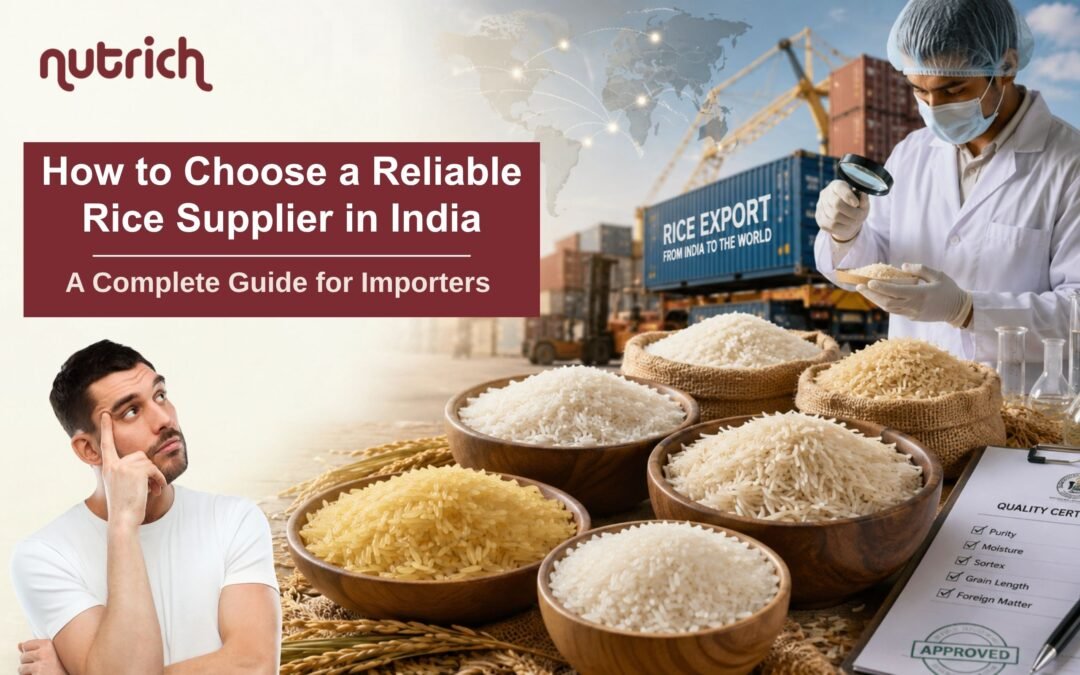
Introduction
Finding a reliable rice supplier in India can determine the success of your import business. The right supplier helps you maintain consistent quality, competitive pricing, timely deliveries, and long-term customer satisfaction. On the other hand, choosing the wrong supplier can lead to quality issues, shipment delays, documentation problems, and financial losses.
Today, India stands among the world’s leading rice-exporting nations. Importers across the UAE, Saudi Arabia, Iraq, Qatar, Oman, Kuwait, Bahrain, Vietnam, the Philippines, Sri Lanka, Malaysia, Indonesia, Singapore, Europe, the USA, Canada, and Africa actively source rice from India due to its diverse product range, strong export infrastructure, and competitive pricing. As a result, the demand for trusted rice suppliers in India and reliable rice exporters in India continues to grow every year.
However, many buyers face challenges during supplier selection. Some focus only on pricing. Others overlook certifications, quality standards, export experience, or documentation capabilities. Consequently, they often encounter shipment disputes, inconsistent product quality, or unexpected import complications.
Therefore, every importer should follow a structured supplier verification process before placing a bulk order. Whether you plan to import Basmati Rice, Non-Basmati Rice, White Rice Silky Sortex, Parboiled Rice, Golden Sella Basmati Rice, Creamy Sella Basmati Rice, or Steam Basmati Rice, supplier evaluation remains essential.
In this comprehensive rice importer’s guide, you will learn how to verify a rice exporter in India, evaluate rice quality standards, review export certifications, inspect packaging, assess logistics capabilities, and identify the factors that separate a genuine rice exporter from an unreliable supplier. You will also discover why global importers increasingly prefer experienced rice export companies such as Nutrich Foods for their sourcing requirements.
Quick Answer: How Do You Choose a Reliable Rice Supplier in India?
Before selecting a rice supplier, follow these essential verification steps:
✔ Verify APEDA registration and Import Export Code (IEC)
✔ Review export experience and international trade history
✔ Check certifications such as FSSAI, ISO, and HACCP
✔ Request product samples for quality evaluation
✔ Verify rice quality parameters and inspection processes
✔ Assess packaging standards and container loading practices
✔ Review export markets and shipment capabilities
✔ Evaluate documentation support and logistics management
✔ Check communication responsiveness and transparency
✔ Partner with an established and trusted rice exporter with proven global supply experience
Importers who follow this checklist significantly reduce sourcing risks and improve long-term procurement success.
Why India Is the Preferred Global Source for Rice Imports
India continues to play a leading role in the global rice trade. Every year, millions of tonnes of rice reach international markets from India, serving importers, wholesalers, distributors, retailers, food service companies, supermarkets, and food manufacturers worldwide. As global demand for quality rice continues to grow, buyers actively search for a reliable rice supplier in India, trusted rice exporter in India, and long-term sourcing partner capable of delivering consistent quality, competitive pricing, and dependable logistics support.
Whether buyers need Basmati Rice, Non-Basmati Rice, Parboiled Rice, Steam Basmati Rice, Golden Sella Basmati Rice, Creamy Sella Basmati Rice, or White Rice Silky Sortex, India offers one of the most diverse rice portfolios available in the international market.
For businesses planning to import rice from India, source bulk rice supplies, or establish long-term procurement partnerships, India remains one of the most preferred sourcing destinations globally.
India’s Position in the Global Rice Export Market
India has established itself as one of the most important rice-exporting countries in the world. The country’s favorable climate, extensive cultivation areas, advanced processing facilities, and strong export ecosystem allow rice suppliers in India to serve buyers across multiple continents.
Today, Indian rice reaches markets across the Middle East, Africa, Southeast Asia, Europe, North America, and other emerging regions. Importers choose Indian rice because they can source multiple rice varieties from a single origin while maintaining quality consistency across shipments.
Furthermore, India’s extensive network of rice mills, processing facilities, rice manufacturers, exporters, logistics providers, and major ports supports large-scale international trade. As a result, buyers can source bulk quantities efficiently and maintain uninterrupted supply chains throughout the year.
The country’s strong position in the Indian rice trade also provides importers with access to experienced rice export companies in India that understand international standards, documentation requirements, and destination-specific regulations.
Why Importers Choose Indian Rice Suppliers
Importers evaluate suppliers based on product quality, reliability, pricing, export experience, certifications, documentation support, and logistics capabilities. Indian rice suppliers consistently perform well across these critical areas.
First, buyers gain access to a wide selection of rice varieties suitable for different markets and consumer preferences.
Second, rice exporters in India can accommodate bulk orders while maintaining quality standards and shipment consistency.
Third, experienced Indian rice exporters understand international trade requirements and provide the documentation needed for smooth customs clearance and efficient supply chain management.
Moreover, many professional rice suppliers in India operate with recognized food safety systems and quality management practices. This approach helps buyers reduce sourcing risks and build stronger long-term procurement partnerships.
Importers also value suppliers that offer transparent communication, timely shipment updates, flexible packaging options, private-label solutions, and dedicated export support. These factors often influence purchasing decisions as much as product quality itself.
Benefits of Importing Rice from India
Importing rice from India offers several advantages for international buyers, distributors, wholesalers, supermarkets, retailers, and food service companies.
Access to Multiple Rice Varieties
India supplies a diverse range of rice products, including:
- Golden Sella Basmati Rice
- Creamy Sella Basmati Rice
- Steam Basmati Rice
- White Rice Silky Sortex
- Parboiled Rice
- Long Grain Rice
- Premium Non-Basmati Rice
This variety allows importers to meet the needs of different customer segments, price points, and regional market preferences.
Competitive Export Pricing
India’s large-scale production capacity, efficient supply chain, and established export infrastructure help importers secure competitive export pricing. Consequently, buyers can improve margins while maintaining product quality and supply consistency.
Strong Quality Standards
Professional rice exporters implement quality-focused procedures throughout procurement, processing, packaging, storage, and shipment preparation. This commitment to quality helps ensure consistency across orders and strengthens buyer confidence.
Reliable Export Infrastructure
India’s major ports, container handling facilities, freight networks, and logistics providers support international rice shipments to destinations worldwide. Therefore, importers benefit from efficient transportation, reliable scheduling, and predictable delivery timelines.
Flexible Packaging Solutions
Rice exporters often provide packaging solutions tailored to market requirements. Common options include:
- 25 kg PP Bags
- 50 kg PP Bags
- Customized Packaging
- Private Label Rice Packaging
- Distributor Packaging Solutions
These options help importers align packaging with customer preferences, retail requirements, and distribution strategies.
Why India Remains the First Choice for Global Rice Buyers
Businesses looking to buy rice from India often benefit from a combination of quality, variety, pricing, and export expertise that few sourcing destinations can match.
India supports a wide range of buyers, including:
- Rice importers
- Rice distributors
- Rice wholesalers
- Supermarket chains
- Food service companies
- Retailers
- Food manufacturers
In addition, rice sourcing in India offers access to experienced exporters, large-scale production capabilities, multiple rice varieties, flexible packaging options, and established logistics networks.
For organizations focused on rice procurement in India, these advantages help reduce sourcing risks, improve supply chain stability, and support long-term business growth.
Quick Answer: Why Do Importers Buy Rice from India?
Importers choose Indian rice suppliers because India offers:
✔ Competitive export pricing
✔ Wide variety of rice products
✔ Strong export infrastructure
✔ Consistent product quality
✔ Reliable documentation support
✔ Global shipping capabilities
✔ Flexible packaging options
✔ Large-scale supply capacity
✔ Experienced export partners
✔ Long-term sourcing opportunities
✔ Reliable rice sourcing solutions
✔ Access to trusted rice exporters in India
These advantages make India one of the preferred sourcing destinations for importers seeking dependable rice suppliers, reliable rice exporters, and sustainable long-term procurement partnerships.
Which Countries Import the Most Rice from India?
Major buyers of Indian rice include:
✔ UAE
✔ Saudi Arabia
✔ Iraq
✔ Qatar
✔ Oman
✔ Kuwait
✔ Bahrain
✔ Vietnam
✔ Philippines
✔ Sri Lanka
✔ Malaysia
✔ Indonesia
✔ Singapore
✔ African Countries
✔ European Countries
✔ USA
✔ Canada
Understanding Different Types of Rice Exported from India
Selecting the right rice variety plays a crucial role in import success. Consumer preferences vary across countries and regions. Therefore, importers should understand the characteristics, applications, and market demand of each rice type before placing an order.
India offers a wide range of premium rice varieties for international markets. As a result, buyers can source products that align with local consumer preferences, pricing strategies, and distribution channels.
Basmati Rice
Basmati Rice remains one of the most sought-after rice categories in the global market. Buyers value its distinctive aroma, long grain structure, superior cooking performance, and excellent elongation after cooking.
Importers across the UAE, Saudi Arabia, Qatar, Oman, Kuwait, Bahrain, Iraq, Europe, the USA, and Canada actively source Basmati Rice from India due to its premium positioning and strong consumer demand.
Golden Sella Basmati Rice
Golden Sella Basmati Rice undergoes a special parboiling process that gives the grain its characteristic golden appearance. Buyers prefer this variety because of its extra-long grains, excellent cooking stability, and attractive presentation.
This variety performs exceptionally well in restaurants, catering businesses, and premium retail markets where appearance and grain separation matter.
Creamy Sella Basmati Rice
Creamy Sella Basmati Rice offers a lighter appearance while maintaining the signature characteristics of premium Basmati Rice. Importers choose this variety for its appealing color, long grain length, and excellent cooking results.
Many distributors and wholesalers prefer Creamy Sella Basmati Rice because it caters to both premium retail and food service segments.
Steam Basmati Rice
Steam Basmati Rice retains its natural aroma and texture through a controlled steaming process. Consumers appreciate its soft texture, authentic flavor, and impressive grain elongation.
As a result, Steam Basmati Rice continues to experience strong demand in supermarkets, hospitality businesses, and international food distribution networks.
Non-Basmati Rice
Non-Basmati Rice serves a broad range of international markets due to its affordability, versatility, and widespread consumer acceptance. Many importers choose Non-Basmati Rice for large-volume distribution programs and government procurement contracts.
White Rice Silky Sortex
White Rice Silky Sortex undergoes advanced sorting and processing to achieve a clean appearance, uniform grain size, and high purity levels.
Importers value this variety because it offers:
- Consistent quality
- Attractive grain appearance
- Excellent cooking performance
- Wide consumer acceptance
This rice category remains popular across Africa, Southeast Asia, the Middle East, and other emerging markets.
Parboiled Rice
Parboiled Rice undergoes a specialized processing method that enhances grain strength and helps retain important nutrients.
Buyers prefer Parboiled Rice because it offers:
- Better grain separation
- Reduced breakage
- Longer shelf life
- Strong cooking performance
Consequently, Parboiled Rice remains a preferred choice for wholesalers, institutional buyers, food service operators, and government supply programs.
Which Rice Variety Is Best for Importers?
The ideal rice variety depends on your target market, customer preferences, pricing strategy, and distribution channel.
For premium retail and hospitality markets, Basmati Rice often delivers the highest value. However, for high-volume distribution and price-sensitive markets, Non-Basmati Rice frequently offers stronger commercial opportunities.
Therefore, importers should evaluate market demand, consumer expectations, and product positioning before selecting a rice variety.
Rice Variety Comparison Table
| Rice Type | Aroma | Grain Length | Popular Markets |
|---|---|---|---|
| Golden Sella Basmati Rice | Strong | Extra Long | UAE, Saudi Arabia, Qatar, Kuwait, Iraq |
| Creamy Sella Basmati Rice | Strong | Extra Long | Middle East, Europe, USA, Canada |
| Steam Basmati Rice | Strong | Long to Extra Long | Global Retail and Food Service Markets |
| White Rice Silky Sortex | Mild | Medium to Long | Africa, Southeast Asia, Middle East |
| Parboiled Rice | Mild | Medium to Long | Africa, Asia, Government Procurement Programs |
Expert Tip for Importers
Before selecting a rice variety, request product specifications, samples, and quality reports from your supplier. This approach allows you to compare grain length, moisture content, purity levels, aroma, and cooking performance before committing to a bulk shipment.
Experienced exporters such as Nutrich Foods assist buyers throughout this evaluation process by providing product information, packaging options, documentation support, and export guidance tailored to specific market requirements.
Which Rice Variety Generates the Highest Demand Globally?
Rice demand varies significantly across regions based on local food preferences, culinary traditions, purchasing power, and consumption patterns. Therefore, importers should understand which rice varieties perform best in their target markets before making sourcing decisions.
Selecting the right rice variety can improve market acceptance, increase customer satisfaction, and support long-term sales growth.
Middle East: Strong Demand for Premium Basmati Rice
The Middle East remains one of the largest import markets for Indian Basmati Rice. Consumers in countries such as the UAE, Saudi Arabia, Qatar, Oman, Kuwait, Bahrain, and Iraq prefer long-grain aromatic rice varieties for traditional dishes and hospitality applications.
Among the most demanded rice varieties in this region are:
- Golden Sella Basmati Rice
- Creamy Sella Basmati Rice
These varieties are highly valued for their extra-long grain length, attractive appearance, excellent grain separation, and premium cooking performance. As a result, importers serving supermarkets, wholesalers, distributors, and food service businesses across the Middle East frequently prioritize these products.
Africa: Growing Demand for White Rice and Parboiled Rice
African markets continue to represent significant opportunities for rice importers worldwide. Buyers often focus on affordability, consistency, cooking performance, and large-volume availability.
The most popular rice varieties across many African markets include:
- White Rice Silky Sortex
- Parboiled Rice
These products offer strong market acceptance due to their versatility, consistent quality, and suitability for daily consumption. Importers supplying wholesale distribution networks, government procurement programs, and retail markets often select these varieties because of their broad consumer appeal.
Europe and North America: Preference for Premium Steam Basmati Rice
Consumers in Europe, the USA, and Canada increasingly seek premium-quality rice products with excellent cooking characteristics and authentic flavor profiles.
Among Indian rice varieties, Steam Basmati Rice continues to experience strong demand because of its:
- Natural aroma
- Long grain structure
- Excellent elongation after cooking
- Premium positioning
Retail chains, specialty food distributors, restaurants, and hospitality businesses frequently source Steam Basmati Rice to meet growing consumer demand for high-quality international food products.
Quick Answer: Which Rice Variety Is Most Demanded in the World?
The most demanded rice varieties often vary by region:
✔ Middle East: Golden Sella Basmati Rice, Creamy Sella Basmati Rice
✔ Africa: White Rice Silky Sortex, Parboiled Rice
✔ Europe & North America: Steam Basmati Rice
✔ Global Premium Segment: Basmati Rice
Importers should evaluate local consumer preferences, pricing expectations, and distribution channels before selecting a rice variety for their target market.
10-Step Rice Supplier Verification Checklist
Choosing a rice supplier involves much more than comparing prices. A low-cost quotation may look attractive initially. However, quality issues, shipment delays, missing documents, or inconsistent supplies can create significant business risks later.
Therefore, importers should follow a structured verification process before placing a bulk order. This checklist helps buyers evaluate rice suppliers objectively and reduce sourcing risks.
1. Verify Company Registration
Start by verifying the supplier’s legal business registration.
A legitimate rice export company should operate through a registered business entity and maintain transparent company information. Importers should review the company’s website, business profile, contact details, and official documentation before initiating commercial discussions.
This simple step helps buyers avoid fraudulent suppliers and build confidence in potential business partners.
2. Check APEDA Registration
APEDA (Agricultural and Processed Food Products Export Development Authority) plays an important role in India’s agricultural export sector.
Before proceeding with a supplier, confirm whether the company holds a valid APEDA registration. This verification helps establish export legitimacy and demonstrates participation in India’s regulated agricultural export ecosystem.
Many importers include APEDA verification as a standard supplier evaluation requirement.
3. Verify Import Export Code (IEC)
An Import Export Code (IEC) allows Indian businesses to participate in international trade activities.
Importers should confirm that their supplier possesses a valid IEC before finalizing commercial agreements. This verification provides an additional layer of confidence during supplier evaluation.
4. Review Export Experience
Export experience often influences supplier reliability.
A company that regularly handles international shipments typically understands export documentation, packaging requirements, customs procedures, freight coordination, and destination-specific regulations.
When evaluating suppliers, ask relevant questions such as:
- Which rice varieties do you export?
- Which international markets do you currently serve?
- How do you manage export documentation?
- How do you handle shipment coordination?
These discussions provide valuable insight into operational capabilities.
5. Check Export Markets
Understanding a supplier’s export markets can reveal valuable information about their capabilities.
Suppliers serving multiple international markets often possess broader knowledge of quality requirements, packaging specifications, labeling standards, and shipping procedures.
Importers should evaluate whether a supplier has experience serving markets similar to their own destination country.
6. Review Certifications
Food safety and quality certifications help buyers assess supplier credibility.
Depending on market requirements, importers may review certifications related to:
- Food safety management
- Quality management systems
- Product traceability
- Export compliance
Certification reviews should form an important part of every supplier verification process.
7. Request Product Samples
Never place a large order without evaluating product samples.
Sample assessment allows buyers to examine:
- Grain length
- Aroma
- Color consistency
- Purity
- Moisture levels
- Cooking performance
A sample evaluation provides first-hand product knowledge and reduces the risk of quality disputes after shipment.
8. Evaluate Communication
Strong communication often reflects strong business practices.
Reliable suppliers respond promptly, answer technical questions clearly, provide requested information, and maintain transparency throughout the sourcing process.
Importers should assess communication quality from the very first interaction.
Clear communication helps prevent misunderstandings and supports long-term business relationships.
9. Assess Logistics Capability
Export success depends on more than product quality.
Importers should evaluate whether a supplier can support:
- Container planning
- Packaging requirements
- Export documentation
- Freight coordination
- Shipment scheduling
A supplier with strong logistics capabilities can help minimize delays and improve supply chain efficiency.
10. Verify Customer References
Whenever possible, request references, testimonials, case studies, or evidence of previous export activity.
This step helps buyers gain additional confidence in a supplier’s reliability, professionalism, and service quality.
Although references should not serve as the only evaluation criterion, they can contribute valuable insight during the decision-making process.
Quick Answer: How Can I Verify a Rice Exporter in India?
Follow this 10-step rice supplier verification checklist:
- Verify company registration.
- Check APEDA registration.
- Confirm Import Export Code (IEC).
- Review export experience.
- Evaluate export markets served.
- Review certifications.
- Request product samples.
- Assess communication quality.
- Evaluate logistics capabilities.
- Verify customer references.
Importers who follow this structured approach can reduce sourcing risks, improve supplier selection, and build stronger long-term procurement partnerships.
Rice Quality Parameters Every Importer Must Check
Rice quality directly affects customer satisfaction, market acceptance, pricing, and repeat business. Therefore, importers should evaluate key quality parameters before selecting a rice supplier in India.
Many shipment disputes occur because buyers and suppliers fail to define quality specifications clearly before order confirmation. As a result, successful importers rely on measurable quality standards rather than assumptions.
Whether you plan to import Basmati Rice, Non-Basmati Rice, Parboiled Rice, Steam Basmati Rice, Golden Sella Basmati Rice, Creamy Sella Basmati Rice, or White Rice Silky Sortex, understanding these quality parameters can help you make informed sourcing decisions.
Moisture Content
Moisture content plays a critical role in rice quality and storage stability.
Excessive moisture can increase the risk of spoilage, fungal growth, quality deterioration, and reduced shelf life. Therefore, importers should always review moisture specifications before approving a shipment.
Many buyers include moisture verification as a mandatory step during rice inspection before export.
Grain Length
Grain length significantly influences market value and consumer preference.
Premium Basmati Rice buyers often prefer extra-long grains because they deliver superior visual appeal and grain elongation after cooking. Meanwhile, many Non-Basmati Rice markets focus on consistency and uniformity.
Importers should request grain length specifications and sample evaluations before finalizing procurement decisions.
Broken Percentage
Broken percentage refers to the proportion of broken grains present within a rice shipment.
This parameter directly affects product grading, pricing, and market acceptance. Lower broken percentages generally command higher market value because buyers associate them with premium quality.
Consequently, importers should clearly define acceptable broken percentage limits before placing bulk orders.
Purity Level
Purity reflects the consistency and uniformity of the rice supplied.
High-purity rice typically contains fewer defects, fewer mixed varieties, and better overall appearance. Importers often prioritize purity because it contributes to stronger customer satisfaction and improved product presentation.
Therefore, buyers should always review purity specifications during supplier evaluation.
Aroma
Aroma serves as one of the most important quality indicators for Basmati Rice.
Consumers often associate rich natural fragrance with authenticity and premium quality. As a result, importers targeting premium retail and hospitality markets frequently evaluate aroma during product sample testing.
Aroma assessment should form part of every Basmati Rice sourcing decision.
Color Consistency
Color consistency influences both visual appeal and perceived product quality.
Uniform color can indicate proper processing, grading, and quality management practices. In contrast, inconsistent color may raise concerns regarding storage conditions, processing standards, or product uniformity.
Importers should inspect color consistency during both sample evaluation and pre-shipment inspection.
Foreign Matter
Foreign matter includes any unwanted material present within the rice shipment.
Examples may include:
- Dust particles
- Husk fragments
- Stones
- Other extraneous materials
Importers should establish clear expectations regarding cleanliness and product presentation before shipment approval.
A clean and well-processed product often contributes to stronger market acceptance and reduced customer complaints.
Head Rice Yield
Head rice yield refers to the percentage of whole grains present after processing.
This parameter often influences commercial value because buyers generally prefer higher proportions of intact grains. Higher head rice yield can contribute to improved appearance, stronger product consistency, and greater customer satisfaction.
Importers should review head rice yield specifications when comparing multiple suppliers.
Rice Quality Parameters Comparison Table
| Quality Parameter | Why It Matters |
|---|---|
| Moisture Content | Supports storage stability and shelf life |
| Grain Length | Influences market value and consumer preference |
| Broken Percentage | Impacts grading, pricing, and quality perception |
| Purity Level | Reflects consistency and product uniformity |
| Aroma | Essential for premium Basmati Rice markets |
| Color Consistency | Enhances visual appeal and market acceptance |
| Foreign Matter | Indicates cleanliness and processing quality |
| Head Rice Yield | Measures the percentage of whole grains |
Expert Tip for Importers
Never rely solely on product descriptions or quotations. Instead, request detailed specifications, product samples, and quality reports before placing bulk orders. Buyers who evaluate rice quality parameters carefully often reduce sourcing risks, improve customer satisfaction, and build stronger long-term supplier relationships.
Rice Sample Testing Before Bulk Orders
Even after verifying a supplier and reviewing quality specifications, importers should never skip sample evaluation. A product sample provides the most accurate representation of what buyers can expect before committing to a bulk order.
Many experienced importers consider sample approval one of the most important stages in the rice procurement process. It helps confirm product quality, aligns expectations between buyer and supplier, and reduces the risk of disputes after shipment.
Whether you plan to import Basmati Rice, Non-Basmati Rice, Parboiled Rice, Steam Basmati Rice, Golden Sella Basmati Rice, Creamy Sella Basmati Rice, or White Rice Silky Sortex, sample testing should always form part of your sourcing process.
Why Sample Evaluation Matters
A product specification sheet provides important technical information. However, a physical sample allows buyers to assess actual product characteristics before placing a large order.
Sample evaluation helps importers:
- Verify product quality
- Compare multiple suppliers
- Assess cooking performance
- Confirm grain appearance
- Evaluate aroma and texture
- Reduce sourcing risks
- Improve purchasing confidence
Furthermore, sample testing helps establish clear quality expectations before commercial negotiations begin.
As a result, both buyers and suppliers benefit from greater transparency throughout the procurement process.
What to Check in Rice Samples
Importers should evaluate several key parameters when reviewing rice samples.
Grain Length and Uniformity
Examine whether the grains appear consistent in size and shape. Uniform grain appearance often indicates better grading and processing standards.
Aroma
For Basmati Rice, aroma plays a major role in product acceptance. Buyers should assess fragrance characteristics based on target market expectations.
Color and Appearance
Review color consistency and overall visual presentation. Uniform appearance often contributes to stronger retail and wholesale acceptance.
Broken Percentage
Inspect the proportion of broken grains within the sample. This parameter can directly influence pricing, product positioning, and customer satisfaction.
Purity and Cleanliness
Check for dust, husk particles, stones, or other foreign matter. A clean sample generally reflects stronger processing practices.
Cooking Performance
Whenever possible, conduct cooking trials to evaluate:
- Grain elongation
- Texture
- Taste
- Water absorption
- Grain separation
Cooking performance often influences consumer satisfaction more than laboratory specifications alone.
Third-Party Inspection Options
For larger transactions, importers may choose to use independent inspection agencies to verify product quality before shipment.
Third-party inspections provide an additional layer of confidence by offering objective product assessments and shipment verification.
SGS Inspection
SGS is one of the internationally recognized inspection, testing, and verification organizations used across global trade.
Importers may request SGS inspections to verify product specifications, packaging conditions, quantity, and shipment readiness before dispatch.
Many buyers use SGS services as part of their supplier risk management strategy.
Bureau Veritas Inspection
Bureau Veritas provides inspection, testing, and certification services for international trade and supply chain operations.
Importers may engage Bureau Veritas to conduct independent quality assessments and shipment inspections before cargo loading.
Third-party verification can help strengthen buyer confidence, particularly for first-time transactions or large-volume purchases.
Quick Answer: Can I Get Rice Samples Before Placing an Order?
Yes. Most professional rice exporters can provide product samples before bulk order confirmation.
Importers should use samples to evaluate:
✔ Grain length
✔ Aroma
✔ Color consistency
✔ Broken percentage
✔ Purity levels
✔ Cooking performance
✔ Overall product suitability
For larger orders, buyers may also consider independent inspections through organizations such as SGS or Bureau Veritas to verify shipment quality before dispatch.
Expert Tip for Importers
Never approve a bulk rice shipment based solely on photographs, product brochures, or quotations. Sample evaluation and independent inspection provide valuable insights that can help prevent quality disputes, reduce sourcing risks, and support long-term supplier relationships.
Essential Rice Export Documents Explained
Documentation plays a critical role in international rice trade. Even when product quality, pricing, and logistics align perfectly, missing or incorrect paperwork can delay customs clearance, increase costs, and disrupt supply chains.
Therefore, importers should understand the key documents commonly used during rice exports from India. Reviewing documentation requirements before shipment helps buyers avoid unnecessary delays and ensures smoother import operations.
While document requirements may vary by destination country, several documents frequently appear in international rice shipments.
Commercial Invoice
The Commercial Invoice serves as one of the most important documents in an export transaction.
This document typically contains:
- Seller information
- Buyer information
- Product description
- Quantity shipped
- Unit price
- Total shipment value
- Trade terms
Customs authorities often use the Commercial Invoice to determine shipment value and process import clearance procedures.
Importers should carefully review invoice details before shipment dispatch to ensure accuracy and consistency.
Packing List
The Packing List provides detailed information about how goods have been packed and shipped.
It commonly includes:
- Number of bags
- Packaging type
- Gross weight
- Net weight
- Container details
- Product specifications
Customs officials, freight forwarders, and warehouse operators often rely on the Packing List during cargo handling and verification processes.
Bill of Lading
The Bill of Lading (B/L) serves as an important transportation document issued by the shipping carrier.
This document generally acts as:
- Evidence of shipment
- Receipt of goods
- Transportation contract
Importers typically require the Bill of Lading to claim cargo upon arrival at the destination port.
Because of its importance, buyers should verify shipment details carefully before document release.
Phytosanitary Certificate
Many countries require a Phytosanitary Certificate for agricultural imports.
Plant health authorities issue this document to certify that the shipment complies with applicable plant health requirements and inspection procedures.
Importers should confirm destination-country requirements before shipment because phytosanitary regulations can vary between markets.
Certificate of Origin
The Certificate of Origin identifies the country where the rice was produced or processed.
Customs authorities often use this document to:
- Verify product origin
- Determine applicable duties
- Process trade agreement benefits
- Support import clearance procedures
Many importing countries request this document as part of standard customs documentation.
Fumigation Certificate
Certain countries require proof that agricultural cargo has undergone approved fumigation treatment before shipment.
A Fumigation Certificate helps demonstrate compliance with specific import regulations designed to protect local agriculture and biosecurity systems.
Importers should verify destination-country requirements because fumigation rules differ across international markets.
Insurance Documents
Cargo insurance helps protect buyers and sellers against potential losses during transportation.
Insurance documents typically provide details regarding:
- Coverage terms
- Insured value
- Shipment information
- Claim procedures
Although insurance requirements may vary depending on trade terms, many importers consider cargo insurance an important risk-management tool.
Quick Answer: What Export Documents Are Required for Rice Shipments?
Common documents used in international rice exports include:
✔ Commercial Invoice
✔ Packing List
✔ Bill of Lading
✔ Phytosanitary Certificate
✔ Certificate of Origin
✔ Fumigation Certificate
✔ Insurance Documents
Depending on the destination country, additional documents may also be required. Therefore, importers should always confirm documentation requirements with customs authorities, logistics partners, and suppliers before shipment.
Expert Tip for Importers
Request copies of all export documents before cargo dispatch. Early document verification helps identify discrepancies, reduces customs clearance issues, and minimizes the risk of shipment delays at the destination port.
Rice Export Pricing, Freight, and Shipping Explained
Price plays an important role in every rice import decision. However, experienced buyers know that the lowest quotation does not always result in the lowest landed cost.
Rice export pricing involves multiple factors, including product specifications, packaging requirements, shipping costs, destination markets, and trade terms. Therefore, importers should understand the key elements that influence pricing before comparing suppliers.
A clear understanding of export pricing helps buyers evaluate quotations accurately, avoid unexpected costs, and make informed purchasing decisions.
Factors Affecting Rice Export Prices
Several factors can influence the final export price of rice.
Rice Variety
Different rice varieties command different market values. Premium Basmati Rice products often carry higher prices than standard Non-Basmati Rice due to their grain length, aroma, and market demand.
Product Specifications
Factors such as grain length, broken percentage, purity levels, moisture content, and quality grade can affect pricing.
Packaging Requirements
Custom packaging, branded bags, private-label solutions, and specialized packaging materials may increase overall costs.
Order Volume
Larger orders may provide opportunities for better pricing efficiencies due to economies of scale.
Market Conditions
Global demand, seasonal production trends, currency fluctuations, and trade policies can influence export prices throughout the year.
Freight and Logistics
Ocean freight rates, container availability, destination ports, and shipping routes can significantly impact total import costs.
For this reason, importers should evaluate the complete landed cost rather than focusing solely on product pricing.
FOB vs CIF Pricing
Many rice export quotations use internationally recognized trade terms known as Incoterms.
Among the most common are FOB and CIF.
Understanding these terms helps buyers compare quotations accurately and determine responsibility for transportation costs.
FOB (Free on Board)
Under FOB terms, the supplier delivers the goods onto the vessel at the designated port of shipment.
The buyer generally assumes responsibility for:
- Ocean freight
- Cargo insurance
- Destination charges
- Import clearance
- Inland transportation after arrival
Many experienced importers prefer FOB pricing because it provides greater control over freight arrangements.
CIF (Cost, Insurance and Freight)
Under CIF terms, the supplier arranges and pays for:
- Ocean freight
- Insurance coverage
- Transportation to the destination port
The buyer remains responsible for import clearance, duties, taxes, and destination-country charges.
Many first-time importers find CIF pricing easier because the supplier manages a larger portion of the shipping process.
Rice Freight Costs
Freight costs represent a significant component of total import expenses.
Several factors can influence shipping costs:
- Destination country
- Destination port
- Shipping route
- Container availability
- Fuel costs
- Seasonal demand
- Carrier schedules
Freight markets can change frequently. Therefore, buyers should request updated freight quotations when planning imports.
Comparing total landed cost often provides a more accurate picture than comparing product prices alone.
Container Loading Process
Proper container loading helps protect product quality during transportation and reduces the risk of cargo damage.
Export shipments typically involve:
- Product preparation
- Packaging verification
- Weight confirmation
- Container inspection
- Cargo loading
- Container sealing
- Shipment dispatch
Careful loading practices help improve shipment security and support smoother logistics operations throughout the supply chain.
Export Packaging Options
Packaging plays an important role in product protection, transportation efficiency, and market presentation.
Common export packaging options include:
- 25 kg PP Bags
- 50 kg PP Bags
- Customized Packaging
- Private Label Packaging
- Retail-Oriented Packaging
- Distributor Packaging Solutions
Importers should select packaging based on market requirements, storage conditions, customer preferences, and distribution channels.
Appropriate packaging helps maintain product quality while supporting brand presentation and logistics efficiency.
Quick Answer: What Is the Difference Between FOB and CIF?
| FOB (Free on Board) | CIF (Cost, Insurance and Freight) |
|---|---|
| Supplier loads goods at the export port | Supplier arranges freight to destination port |
| Buyer arranges ocean freight | Supplier arranges ocean freight |
| Buyer arranges insurance | Supplier arranges insurance |
| Buyer controls shipping arrangements | Supplier manages major shipping arrangements |
| Often preferred by experienced importers | Often preferred by first-time importers |
Both options can work effectively. The best choice depends on the buyer’s logistics experience, freight management capabilities, and sourcing strategy.
Expert Tip for Importers
When comparing supplier quotations, always evaluate the total landed cost rather than focusing only on product price. Freight charges, insurance, duties, destination fees, and inland transportation can significantly affect the final cost of imported rice.
Common Red Flags When Choosing a Rice Exporter
Finding a rice supplier is easy. Finding a reliable rice exporter is much more challenging.
Every year, importers face issues such as inconsistent product quality, shipment delays, documentation problems, payment disputes, and unmet specifications. In many cases, these problems originate from supplier selection mistakes that buyers could have identified earlier.
Therefore, importers should remain alert to warning signs during the supplier evaluation process. Recognizing these red flags early can help reduce sourcing risks and protect business relationships.
Unrealistically Low Prices
Price matters in international trade. However, quotations that appear significantly lower than prevailing market rates should prompt additional scrutiny.
In some cases, unusually low prices may indicate:
- Lower product specifications
- Quality inconsistencies
- Hidden costs
- Supply limitations
- Misaligned expectations
Professional buyers typically compare quotations from multiple suppliers before making purchasing decisions.
Instead of focusing solely on the lowest price, evaluate the overall value, product quality, logistics support, and supplier reliability.
No Certifications or Compliance Information
Reliable exporters generally maintain transparency regarding their certifications, quality systems, and compliance practices.
If a supplier cannot provide basic information regarding food safety procedures, quality controls, or export-related compliance, buyers should investigate further before proceeding.
Transparency often reflects professionalism and operational maturity.
No Export History
Export experience can play an important role in shipment success.
Suppliers with limited or unclear export backgrounds may face challenges related to:
- Documentation preparation
- International logistics
- Destination-country requirements
- Customs procedures
- Shipment coordination
Before placing large orders, buyers should understand a supplier’s export capabilities and experience level.
No Samples Available
A supplier who refuses to provide product samples creates unnecessary uncertainty.
Sample evaluation helps buyers assess:
- Grain quality
- Aroma
- Appearance
- Purity
- Cooking performance
Without samples, importers have limited ability to validate product suitability before committing to a bulk purchase.
For this reason, experienced buyers often treat sample evaluation as a standard part of the sourcing process.
Poor Communication
Communication quality often reflects overall business reliability.
Warning signs may include:
- Delayed responses
- Incomplete answers
- Inconsistent information
- Lack of transparency
- Difficulty obtaining requested documents
Strong communication supports smoother transactions, faster problem resolution, and better long-term business relationships.
Therefore, importers should evaluate communication quality from the earliest stages of supplier engagement.
Lack of Traceability
Traceability helps buyers understand product sourcing, processing, and supply chain management practices.
When suppliers cannot explain product origins, quality controls, or shipment processes clearly, buyers may face increased operational risk.
Importers should work with suppliers who can provide transparent information regarding product specifications, production processes, and shipment documentation.
Clear traceability contributes to greater confidence and improved supply chain visibility.
Quick Answer: How Can I Avoid Rice Export Scams?
Importers can reduce sourcing risks by watching for these common warning signs:
✔ Unrealistically low prices
✔ Limited transparency regarding certifications or compliance
✔ Unclear export experience
✔ Refusal to provide samples
✔ Poor communication practices
✔ Lack of product traceability
✔ Incomplete documentation
✔ Inconsistent product information
✔ Pressure to make immediate payments
✔ Limited willingness to answer technical questions
The most successful importers combine supplier verification, sample evaluation, documentation reviews, and ongoing communication to build strong long-term sourcing partnerships.
Expert Tip for Importers
If a supplier appears too good to be true, conduct additional due diligence before proceeding. A structured evaluation process often costs far less than resolving quality disputes, shipment delays, or sourcing problems after an order has been placed.
Why Importers Worldwide Choose Nutrich Foods
Selecting the right rice supplier can significantly impact product quality, customer satisfaction, supply chain efficiency, and long-term business growth. Importers often look for a reliable rice supplier in India that can provide consistent quality, export expertise, documentation support, and dependable delivery.
Nutrich Foods has established itself as a trusted rice supplier in India and rice exporter in India by focusing on quality, transparency, and customer-centric export solutions. Since 1990, the company has served international buyers across multiple markets while maintaining a strong commitment to quality and reliability.
Export-Focused Rice Supply Solutions
International buyers require more than just a product supplier. They need an Indian rice supplier that understands export requirements, international trade procedures, packaging specifications, and destination market expectations.
Nutrich Foods supports importers, distributors, wholesalers, supermarkets, retailers, food service companies, and food manufacturers looking to import rice from India. The company provides export-oriented rice sourcing solutions designed to support long-term business relationships and consistent supply requirements.
Whether buyers require Basmati Rice, Non-Basmati Rice, Parboiled Rice, or customized export packaging, Nutrich Foods works closely with customers to support their sourcing objectives.
Consistent Quality Standards
Quality remains one of the most important factors when choosing a reliable rice exporter in India.
Nutrich Foods follows strict quality-focused practices and operates with a strong emphasis on clean and hygienic operations. The company maintains a commitment to uncompromising quality throughout sourcing, processing, packaging, and export activities.
Importers seeking a trusted rice supplier in India often prioritize consistency because product quality directly impacts customer satisfaction, brand reputation, and repeat business.
The company’s quality-focused approach is supported by internationally recognized certifications and industry accreditations.
Global Export Experience
Experience plays a critical role in international rice trade.
Since 1990, Nutrich Foods has developed extensive experience in supplying agro commodities to international markets. With exports reaching 22+ countries and a portfolio of 35+ products, the company understands the complexities of global sourcing, logistics coordination, export documentation, and international trade requirements.
This experience helps buyers reduce sourcing risks while working with an Indian rice exporter familiar with international market expectations.
Reliable Documentation Support
Documentation remains a critical part of successful rice exports from India.
Nutrich Foods supports buyers throughout the export process by facilitating shipment-related documentation required for international trade. Proper documentation helps streamline customs procedures, improve shipment visibility, and reduce the likelihood of avoidable delays.
Importers sourcing rice from India often value suppliers who understand export documentation requirements and can support efficient shipment processing.
Efficient Packaging and Logistics
Packaging and logistics directly influence product protection and shipment efficiency.
Nutrich Foods offers export packaging solutions suitable for international shipments, including:
- 25 kg PP Bags
- 50 kg PP Bags
The company focuses on packaging solutions that support safe handling, storage, transportation, and product presentation across global markets.
Efficient logistics planning helps ensure products move smoothly through the supply chain and reach buyers in suitable condition.
Rice Varieties Offered
Nutrich Foods supplies a range of rice products for importers seeking a dependable rice manufacturer and exporter in India.
White Rice Silky Sortex
White Rice Silky Sortex is widely preferred for its clean appearance, uniform grain structure, and broad market acceptance. It remains a popular choice among wholesalers, distributors, retailers, and food service businesses.
Parboiled Rice
Parboiled Rice offers strong cooking performance, grain stability, and versatility across various food applications. It continues to be a preferred option in many international markets.
Golden Sella Basmati Rice
Golden Sella Basmati Rice is known for its attractive golden color, extra-long grain structure, and excellent cooking characteristics. Buyers seeking a reliable Basmati rice supplier in India frequently consider this premium variety.
Creamy Sella Basmati Rice
Creamy Sella Basmati Rice combines appealing grain appearance with strong demand across wholesale, retail, and hospitality sectors. It remains one of the most sought-after Basmati Rice varieties in global markets.
Steam Basmati Rice
Steam Basmati Rice is valued for its aroma, texture, and grain elongation after cooking. It is widely used across premium retail, food service, and hospitality channels.
Serving Importers Across Global Markets
Nutrich Foods supports buyers across diverse international markets and continues to strengthen its global presence through reliable supply solutions and customer-focused service.
The company serves importers and distribution networks across:
- UAE
- Saudi Arabia
- Qatar
- Oman
- Kuwait
- Bahrain
- Iraq
- Vietnam
- Philippines
- Sri Lanka
- Malaysia
- Indonesia
- Singapore
- African Markets
- European Markets
- USA
- Canada
Accreditations and Certifications
Nutrich Foods demonstrates its commitment to quality, food safety, and export excellence through recognized certifications and industry affiliations, including:
- Government Recognized Two Star Export House
- ISO 22000 Certified
- APEDA Registered
- FIEO Member
- Halal Certified
- Non-GMO
Why Buyers Choose Nutrich Foods
Importers looking for a reliable rice supplier in India often evaluate experience, quality, export capabilities, certifications, logistics support, and long-term reliability.
Nutrich Foods combines:
✔ 30+ Years of Industry Experience
✔ 22+ Export Countries
✔ 35+ Product Portfolio
✔ 3+ Operational Units
✔ Government Recognized Export House Status
✔ International Certifications and Accreditations
✔ Export Packaging Solutions
✔ Buyer-Focused Service Approach
For businesses looking to buy rice from India, source rice in bulk, or establish a long-term partnership with a trusted rice exporter in India, Nutrich Foods offers the experience, product range, and export expertise required to support international sourcing needs.
Frequently Asked Questions
1. What is the best rice supplier in India?
The best rice supplier in India combines consistent product quality, export experience, food safety standards, reliable documentation support, and efficient logistics capabilities. Importers should evaluate supplier credibility, product range, certifications, packaging options, and customer support before selecting a long-term sourcing partner.
2. How do I choose a reliable rice supplier in India?
Start by reviewing company credentials, export experience, certifications, product quality standards, and communication practices. Request product samples, verify documentation capabilities, compare suppliers, and assess logistics support. A structured evaluation process helps reduce sourcing risks and improve long-term procurement success.
3. Why do importers prefer buying rice from India?
India offers a wide range of rice varieties, competitive pricing, strong agricultural infrastructure, and extensive export expertise. Importers also benefit from diverse packaging options, established supply chains, and access to both Basmati and Non-Basmati Rice products for global markets.
4. How can I verify a rice exporter in India?
Importers should review company registration, APEDA credentials, export history, certifications, customer references, product samples, and communication quality. Verifying these factors helps buyers assess reliability and minimize sourcing risks before committing to large-volume purchases.
5. What certifications should a rice exporter have?
Buyers commonly review APEDA registration, ISO certifications, food safety certifications, Halal certification where required, and other export-related compliance standards. Certifications demonstrate a supplier’s commitment to quality management, food safety, and international trade requirements.
6. Can I get rice samples before placing an order?
Yes. Most professional rice exporters provide product samples before bulk order confirmation. Sample evaluation helps buyers assess grain quality, aroma, appearance, cooking performance, purity, and product suitability before proceeding with commercial agreements.
7. Which rice variety is best for importers?
The best rice variety depends on the target market, customer preferences, and product positioning. Basmati Rice is popular in premium retail and hospitality sectors, while Parboiled Rice and Non-Basmati Rice often serve wholesale, institutional, and large-volume distribution markets.
8. What is the difference between Basmati and Non-Basmati Rice?
Basmati Rice is known for its long grains, distinctive aroma, and premium positioning. Non-Basmati Rice includes a broader range of rice varieties with different grain lengths, textures, and applications. Market demand and end-user preferences often determine the best choice.
9. What export documents are required for rice shipments?
Common rice export documents include the Commercial Invoice, Packing List, Bill of Lading, Certificate of Origin, Phytosanitary Certificate, Fumigation Certificate, and insurance-related documents. Requirements may vary depending on destination-country import regulations.
10. What is the difference between FOB and CIF pricing?
Under FOB terms, the buyer typically arranges freight and insurance after cargo is loaded at the export port. Under CIF terms, the supplier arranges freight and insurance to the destination port. Importers should compare both options based on logistics preferences.
11. How do I calculate the landed cost of imported rice?
Landed cost includes product value, freight charges, insurance, customs duties, taxes, destination handling fees, and inland transportation costs. Importers should evaluate the complete cost structure rather than comparing supplier quotations based only on product pricing.
12. How can I avoid rice export scams?
Avoid suppliers that offer unrealistic prices, refuse to provide samples, lack transparency, provide incomplete information, or avoid technical discussions. Conduct supplier verification, review documentation carefully, and maintain clear communication throughout the sourcing process.
13. Why is rice sample testing important before bulk orders?
Sample testing helps importers confirm product specifications before shipment. It allows buyers to evaluate grain length, aroma, purity, appearance, moisture characteristics, and cooking performance while reducing the risk of quality disputes after delivery.
14. What packaging options are available for rice exports?
Rice exporters commonly offer packaging options such as 25 kg PP Bags, 50 kg PP Bags, bulk packaging, and customized solutions based on buyer requirements. Packaging selection depends on distribution channels, storage conditions, and market preferences.
15. What makes a rice exporter reliable?
A reliable rice exporter demonstrates consistent quality, transparent communication, export experience, proper certifications, documentation expertise, efficient logistics support, and a commitment to customer satisfaction. Long-term reliability often matters more than simply offering the lowest price.
16. What is the minimum order quantity for rice exports from India?
The minimum order quantity (MOQ) depends on the rice variety, packaging requirements, destination country, and shipping method. Many international buyers begin with container-based orders to optimize freight costs and improve supply chain efficiency. Importers should discuss MOQ requirements directly with their chosen rice supplier before finalizing procurement plans.
17. Can I buy rice directly from an Indian exporter?
Yes. Importers, distributors, wholesalers, retailers, supermarkets, and food service companies frequently purchase directly from Indian rice exporters. Direct sourcing often improves communication, simplifies procurement, enhances transparency, and helps buyers build long-term partnerships with reliable rice suppliers in India.
18. Can Indian rice exporters provide private label packaging?
Many rice exporters in India offer private label packaging and customized branding solutions for international buyers. Options may include custom bag designs, retail packaging, distributor packaging, and market-specific labeling requirements. Private label solutions help importers strengthen brand recognition and create a unique market presence.
19. Which countries import the most rice from India?
Indian rice is exported to numerous international markets. Major destinations include the UAE, Saudi Arabia, Iraq, Qatar, Oman, Kuwait, Bahrain, Vietnam, Philippines, Sri Lanka, Malaysia, Indonesia, Singapore, African countries, European countries, the USA, and Canada. Demand continues to grow as buyers seek dependable rice sourcing solutions from India.
20. How do I start importing rice from India?
Importers should begin by identifying a reliable rice supplier in India, verifying company credentials, reviewing certifications, requesting product samples, evaluating quality specifications, comparing quotations, confirming documentation requirements, and finalizing logistics arrangements. Following a structured sourcing process helps reduce risks and supports successful long-term procurement partnerships.
Conclusion: Ready to Source Rice from India?
Choosing the right rice supplier in India can significantly influence product quality, customer satisfaction, supply chain stability, and long-term business success. While pricing remains important, experienced importers understand that successful sourcing depends on much more than obtaining the lowest quotation.
Before selecting a rice exporter in India, buyers should carefully verify supplier credentials, evaluate rice quality parameters, review certifications, request product samples, assess documentation capabilities, and understand logistics requirements. A structured sourcing approach helps reduce risks, improve procurement decisions, and support smooth international trade operations.
Importers should also focus on building long-term partnerships with suppliers who demonstrate transparency, consistent quality, strong communication, and a commitment to customer success. Reliable sourcing relationships often create greater value than short-term purchasing decisions based solely on price.
For businesses looking to import rice from India, source bulk rice supplies, or establish a dependable procurement partner, choosing an experienced and export-focused supplier is essential.
Nutrich Foods combines decades of industry experience, international export expertise, recognized certifications, quality-focused operations, and a diverse portfolio of rice products to support buyers across global markets. From White Rice Silky Sortex and Parboiled Rice to Golden Sella Basmati Rice, Creamy Sella Basmati Rice, and Steam Basmati Rice, the company helps importers access reliable rice sourcing solutions tailored to their requirements.
Whether you are a distributor, wholesaler, supermarket chain, food service company, retailer, trader, or food manufacturer, Nutrich Foods is committed to supporting your sourcing objectives with quality products, export-ready packaging, documentation assistance, and dependable customer service.
Looking for a Reliable Rice Supplier in India?
If you are planning to import rice from India, source bulk rice supplies, or establish a long-term partnership with a trusted rice exporter in India, Nutrich Foods is ready to support your business requirements.
With decades of industry experience, international export expertise, recognized certifications, and a commitment to quality, Nutrich Foods helps importers, distributors, wholesalers, supermarkets, retailers, food service companies, and food manufacturers source high-quality rice products from India with confidence.
Whether you require White Rice Silky Sortex, Parboiled Rice, Golden Sella Basmati Rice, Creamy Sella Basmati Rice, or Steam Basmati Rice, our team can help you identify the right solution for your market.
Start your inquiry today:
Website: https://nutrichfoods.com/
Email: market@nutrichfoods.com
Phone / WhatsApp: +91 96572 42222
Connect with Nutrich Foods today to discuss your requirements, request product specifications, explore packaging options, or receive assistance with your rice sourcing needs from India.
Partner with a reliable rice supplier and rice exporter from India and build a stronger, more dependable supply chain for long-term growth.