
Introduction
The global demand for maize-based products continues to rise. Food manufacturers, snack producers, and feed industries actively search for reliable raw materials. Among these, corn grits and corn flour dominate industrial usage. However, many buyers still ask one key question: corn grits vs corn flour—which one fits better for industrial and export use?
This confusion slows down sourcing decisions. It also affects product quality and processing efficiency. Therefore, understanding the difference between corn grits and corn flour becomes essential for importers, distributors, and manufacturers.
Corn grits offer a coarse texture and high durability. Industries use them in cornflakes, extruded snacks, and brewing. On the other hand, corn flour delivers a fine texture. Manufacturers use it in baking, thickening, and processed foods. While both products come from maize, they serve very different industrial purposes.
Moreover, global buyers now focus on consistent quality, export-grade specifications, and reliable supply chains. This shift makes supplier selection just as important as product selection. Companies need partners who deliver bulk quantities, maintain standards, and support international trade.
This is where Nutrich Foods stands out. As a leading corn grits supplier in India and a trusted maize exporter, Nutrich Foods supports global buyers with premium quality products, bulk supply capabilities, and strong export expertise.
In this guide, you will clearly understand:
- What are corn grits and corn flour
- Key differences in texture, processing, and usage
- Industrial applications and global demand
- Export trends, pricing, and supplier insights
- Which product works best for your business
By the end, you will confidently decide which product suits your industrial or export requirements—and why choosing the right supplier matters.
What is the Difference Between Corn Grits and Corn Flour?
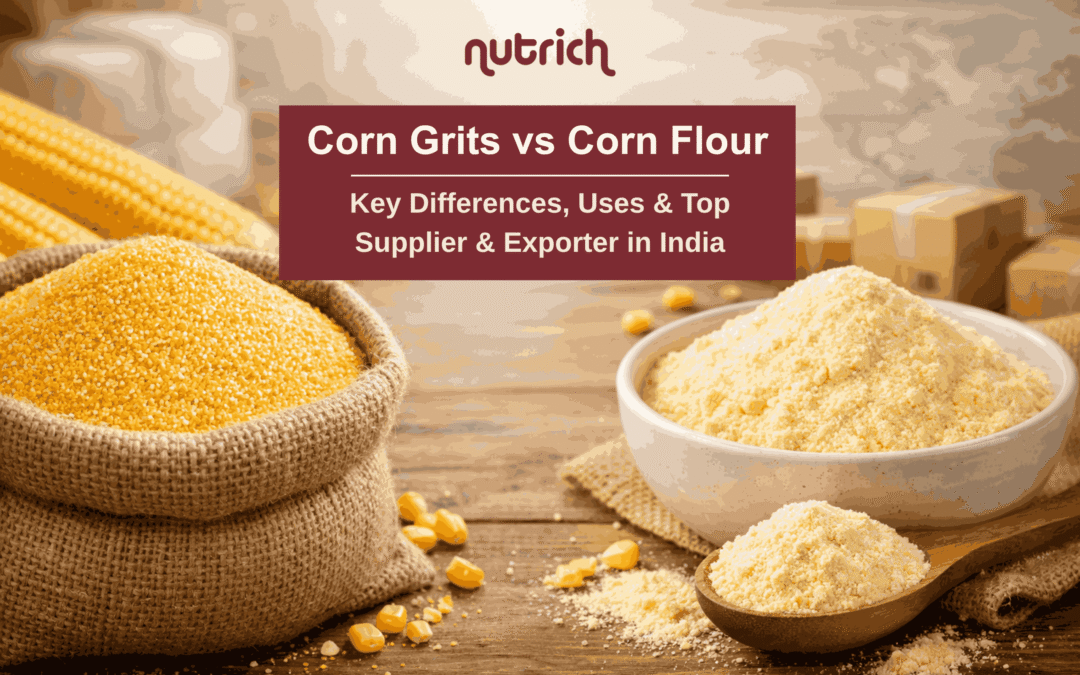
Corn grits and corn flour both come from maize, but they differ in texture, processing, and industrial use. Corn grits have a coarse texture and manufacturers use them in cereals, snacks, and breweries. Corn flour has a fine texture and producers use it in baking and thickening. For industrial and export use, buyers prefer corn grits due to higher demand and consistency.
Quick Differences Between Corn Grits and Corn Flour
- Texture: Corn grits have a coarse, granular structure, while corn flour has a fine powder consistency
- Processing: Millers produce corn grits through coarse grinding, while they grind corn flour into a fine form
- Industrial Use: Manufacturers use corn grits in cornflakes, snacks, and brewing, whereas they use corn flour in baking and food processing
- Export Demand: Global buyers prefer corn grits for large-scale industrial applications
- Functionality: Corn grits provide structure, while corn flour acts as a thickening agent
Many buyers search for the difference between corn grits and corn flour before making a purchase decision. However, most industrial users prefer corn grits because they deliver better processing performance, longer shelf life, and higher export demand across global markets.
What Are Corn Grits?
Corn grits are coarsely ground maize particles produced through a controlled milling process. Millers remove the outer husk and germ from corn kernels. Then, they break the endosperm into medium to coarse granules. This process creates uniform particles suitable for industrial applications.
Manufacturers widely use corn grits in breakfast cereals, extruded snacks, and brewing industries. Due to their structure, corn grits deliver consistent texture and high processing efficiency. As a result, they remain a preferred raw material for large-scale food production.
Global demand for corn grits continues to grow. Food companies and feed manufacturers actively source bulk quantities from reliable suppliers. Therefore, choosing a trusted corn grits supplier in India becomes critical for maintaining quality and supply consistency.
What Is Corn Flour?
Corn flour is a finely ground maize product created through advanced milling techniques. During processing, millers grind cleaned corn kernels into a soft, powder-like consistency. This fine texture allows easy mixing and smooth integration into food formulations.
Food manufacturers use corn flour in baking, sauces, coatings, and processed foods. It acts as a thickening agent and improves texture in various recipes. Additionally, industries prefer corn flour for applications that require fine blending and uniform consistency.
Although corn flour serves multiple purposes, it offers lower structural strength compared to corn grits. Therefore, industries select it mainly for food processing rather than heavy industrial applications.
Corn Grits Meaning, Texture, and Particle Size
Corn grits refer to coarse maize granules derived from the endosperm of the corn kernel. They feature a granular texture that ranges from medium to large particle sizes. This structure plays a key role in industrial processing.
Manufacturers classify corn grits based on size specifications. These include large grits, medium grits, and fine grits. Each grade serves a specific purpose. For example, flaking grits work best in cornflakes production, while smaller grits suit snack manufacturing.
The particle size of corn grits directly affects product quality. Uniform granules ensure better cooking performance, improved expansion in extrusion, and consistent texture in finished products. Therefore, industries demand precise size control from suppliers.
Moreover, corn grits offer low moisture content and high shelf stability. These properties make them ideal for bulk storage, export, and long-distance shipping.
Corn Flour Meaning, Texture, and Fine Milling Process
Corn flour represents finely milled maize processed into a smooth powder. Millers use high-speed grinding systems to achieve ultra-fine particle size. This process ensures uniform consistency across batches.
The fine texture of corn flour allows easy absorption of liquids. As a result, it works effectively in baking, thickening sauces, and food processing applications. Its smooth structure helps create soft textures in finished products.
However, the fine particle size also reduces its structural strength. Unlike corn grits, corn flour does not provide shape or crunch in industrial applications. Therefore, manufacturers select it mainly for blending rather than structural use.
Additionally, proper milling and quality control play a crucial role in corn flour production. Consistent particle size, controlled moisture content, and clean processing ensure high-quality output suitable for domestic and export markets.
Corn Grits vs Corn Flour
Corn grits and corn flour differ in texture, processing method, industrial application, and global demand. This comparison gives manufacturers, importers, and bulk buyers a clear understanding of both products, helping them choose the right option based on specific use cases and export requirements.
Understanding the difference between corn grits and corn flour helps manufacturers, exporters, and buyers choose the right product for industrial and food applications. While both come from maize, they differ significantly in texture, processing, usage, and market demand.
Texture & Structure
Corn grits have a coarse, granular texture with clearly defined particles. This structure makes them ideal for industrial processing. In contrast, corn flour has a fine, powder-like consistency, making it suitable for smooth blending and food applications.
Processing Method
Corn grits are produced through degermination followed by coarse milling of maize. This process retains particle size and structure. Corn flour, however, is manufactured using advanced fine grinding systems that create a smooth and uniform powder.
Industrial Uses
Corn grits are widely used in cornflakes, breakfast cereals, extrusion snacks, breweries, and animal feed industries. Corn flour is mainly used in baking, sauces, coatings, and thickening applications where a fine texture is required.
Industry Demand
Corn grits see high demand across food processing, snack manufacturing, and cereal industries due to their scalability and performance. Corn flour has moderate demand and is mostly used in specialized food processing segments.
Export Demand
Corn grits have strong global demand, especially in markets like Vietnam, UAE, Saudi Arabia, Indonesia, and Malaysia. Corn flour maintains stable demand globally but is more limited to food-focused applications rather than large-scale industrial use.
Pricing & Export Value
Corn grits offer competitive bulk pricing with strong export value due to high-volume industrial demand. Corn flour pricing remains slightly lower or similar depending on grade and processing quality, with moderate export value.
Shelf Life & Storage
Corn grits generally have a longer shelf life due to lower moisture content and coarse structure. Corn flour has a moderate shelf life and requires controlled storage conditions to maintain quality and prevent spoilage.
Moisture Content
Corn grits typically have lower moisture content, making them suitable for long-distance export. Corn flour may have slightly higher moisture levels and requires strict quality control during storage and transportation.
Applications in Industry
Corn grits are used for structural applications such as cereals and extrusion products where particle integrity matters. Corn flour is used for functional applications like binding, thickening, and improving texture in food products.
Key Takeaway for Buyers and Importers
Corn grits dominate industrial and export markets because they deliver better processing performance, higher consistency, and stronger global demand. In contrast, corn flour serves niche applications where fine texture and blending matter more than structure.
Market Insight
Global buyers, especially in Vietnam, UAE, and Saudi Arabia, actively source bulk corn grits from India due to consistent quality, competitive pricing, and reliable supply chains. As a result, corn grits continue to outperform corn flour in large-scale industrial and export applications.
How Are Corn Grits Made? (Maize Grits Manufacturing Process)
Corn grits production follows a precise, multi-stage milling process. Manufacturers focus on consistency, particle size control, and low moisture content to meet industrial and export standards.
Step-by-Step Corn Grits Manufacturing Process
- Cleaning and Selection
Processors clean raw maize to remove dust, stones, and impurities. High-quality yellow maize ensures better output and uniform grits.
- Conditioning
Technicians adjust moisture levels to prepare kernels for efficient separation. This step improves milling performance and final quality.
- Degermination
Machines remove the germ and outer bran layer from the maize kernel. This step isolates the endosperm, which forms the base of corn grits.
- Milling and Grinding
Millers break the endosperm into coarse particles using controlled grinding systems. They maintain specific size ranges based on industrial requirements.
- Sieving and Grading
Equipment separates grits into different grades such as large, medium, and fine grits. Each grade serves a specific application, including flaking grits for cornflakes.
- Drying and Moisture Control
Operators reduce moisture content to safe levels. This step ensures longer shelf life and stable export quality.
- Packaging for Bulk Supply
Suppliers pack corn grits in 25 kg or 50 kg bags or bulk containers. Proper packaging protects quality during storage and international shipment.
Industrial Relevance of Corn Grits Processing
Corn grits processing focuses on achieving uniform particle size, controlled moisture levels, and consistent quality through degermination, milling, and grading. These parameters ensure reliable performance across industrial applications.
These properties make corn grits suitable for:
• Extruded snack manufacturing, where controlled granulation supports proper expansion and texture
• Brewing and fermentation industries, where starch converts efficiently into fermentable sugars
• Production of flaking grits for cornflakes and breakfast cereals, where specific large-size fractions are required
• Other food processing applications, where consistency and structure are essential
Because of these advantages, global buyers prefer corn grits for industrial use and bulk export from India.
Quality Parameters for Export-Grade Corn Grits
- Consistent particle size specification
- Low moisture content (ensures longer shelf life)
- High purity and minimal impurities
- Uniform color (yellow maize grits preferred)
- Strong packaging for export
Reliable suppliers maintain strict quality control to meet international standards and buyer expectations.
How Is Corn Flour Made? (Corn Milling Process Explained)
Corn flour production involves fine milling techniques that convert maize into a smooth, powder-like product. The process focuses on achieving uniform texture and clean, food-grade quality.
Step-by-Step Corn Flour Manufacturing Process
- Cleaning and Sorting
Processors remove foreign materials from maize kernels to ensure clean raw input.
- Conditioning
Technicians adjust moisture levels to support efficient grinding and improve flour quality.
- Degermination (Optional)
In some processes, operators remove the germ to enhance shelf life and improve texture.
- Fine Grinding (Milling)
High-speed milling machines grind maize into fine powder. This step defines the texture and usability of corn flour.
- Sieving and Particle Control
Equipment ensures uniform particle size across batches. Fine consistency remains critical for baking and food processing applications.
- Drying and Stabilization
Operators control moisture levels to prevent spoilage and maintain product quality.
- Packaging for Bulk and Export Supply
Suppliers pack corn flour in moisture-resistant bags for domestic and international markets.
Industrial Relevance of Corn Flour Processing
Corn flour serves industries that require fine texture and easy blending. Manufacturers use it in:
- Baking and food production
- Sauces and thickening applications
- Coatings and processed foods
However, corn flour does not provide structural strength. Therefore, industries avoid it in applications like cornflakes or extrusion, where coarse texture plays a key role.
Quality Parameters for Export-Grade Corn Flour
- Fine and uniform particle size
- Controlled moisture content
- High purity and food-grade standards
- Smooth texture for processing
- Proper packaging for storage and export
Key Insight for Industrial Buyers
Corn grits production focuses on structure, durability, and industrial performance. In contrast, corn flour production focuses on smoothness and blending. Therefore, manufacturers and exporters select the product based on application, processing needs, and market demand.
Industrial Use of Corn Grits
Corn grits play a critical role in multiple industrial sectors. Manufacturers prefer corn grits because they offer consistent particle size, structural integrity, and efficient processing performance. As a result, industries across food processing and brewing actively source bulk corn grits from reliable suppliers in India.
Flaking Grits for Cornflakes & Breakfast Cereals
Cornflakes production uses flaking grits, which are a specialized, large-size fraction derived from corn grits. These grits have uniform particle size and high starch content, making them suitable for flaking processes.
During processing:
• Flaking grits undergo cooking and conditioning
• Rollers flatten them into thin flakes
• Controlled heat treatment develops crisp texture
This process requires strict size consistency and purity. Therefore, cereal manufacturers depend on suppliers who can provide uniform flaking grits with precise specifications.
Because of growing demand for ready-to-eat cereals, global buyers continue to increase imports of flaking grits for cornflakes production.
Corn Grits for Extruded Snacks
Corn grits are widely used in the extrusion industry for manufacturing snacks such as puffs, chips, and ready-to-eat products. Their controlled particle size supports proper expansion and consistent texture during processing.
Snack manufacturers prefer corn grits because they:
• Ensure uniform expansion during extrusion
• Provide consistent texture and structure
• Support high-volume industrial production
With rising global demand for snack foods, corn grits remain a key raw material for extrusion-based applications.
Corn Grits for Breweries
Breweries use corn grits as a fermentable carbohydrate source in the brewing process. The starch present in corn grits converts into fermentable sugars during mashing, which improves fermentation efficiency and overall yield.
Corn grits are preferred in brewing because they:
• Provide a clean and consistent starch source
• Support efficient sugar conversion during processing
• Help maintain product consistency across batches
Due to these functional advantages, breweries and beverage manufacturers actively source bulk corn grits for reliable performance and consistent quality in large-scale production.
Industrial Use of Corn Flour
Corn flour supports industries that require fine texture, smooth blending, and functional performance. While it does not provide structure like grits, it plays an important role in food processing. Industries prefer sourcing from a reliable corn flour supplier in India to ensure consistent quality and smooth processing.
Corn Flour for Food Industry & Baking
Food manufacturers use corn flour in baking and processed foods. It improves texture and enhances product consistency.
Common applications include:
- Breads, cakes, and bakery items
- Coatings and batters
- Processed food formulations
Corn flour works well because it mixes easily and distributes evenly. Therefore, industries prefer corn flour for applications that require smooth texture and uniform blending.
Corn Flour for Thickening & Processing
Corn flour acts as a natural thickening agent in sauces, soups, and gravies. It absorbs water quickly and forms a smooth consistency.
Industries use corn flour to:
- Improve viscosity in food products
- Stabilize processed foods
- Enhance texture in ready-to-eat meals
However, corn flour does not perform well in applications that require structure or crunch. Therefore, manufacturers choose it specifically for functional roles rather than structural use.
Key Takeaway for Industrial Buyers
Corn grits dominate industries that require structure, expansion, and processing strength. In contrast, corn flour supports applications that need smooth texture and thickening properties. Therefore, buyers select the product based on end-use, processing requirements, and market demand.
Corn Grits vs Corn Flour – Export Demand and Global Market Trends
Global demand for maize-based products continues to expand. However, corn grits and corn flour show very different growth patterns in international markets. Corn grits dominate industrial demand, while corn flour serves selective food-processing needs.
Importers, distributors, and manufacturers actively search for reliable corn grits exporters from India due to consistent quality, competitive pricing, and strong supply chains. In contrast, corn flour export demand remains stable but limited to specific applications.
From a market perspective, corn grits offer:
- Higher volume demand
- Strong repeat orders
- Wider industrial applications
Global buyers also source corn flour from India for food processing applications, creating steady demand for reliable corn flour exporters.
Countries Importing Corn Grits
Several countries show strong and consistent demand for corn grits, especially for food processing, cereals, and feed industries.
Vietnam
Vietnam stands as a major importer of corn grits. The country has a large food processing and snack manufacturing industry. Buyers in Vietnam actively source corn grits for cornflakes and extrusion applications from India due to cost efficiency and quality consistency.
United Arab Emirates (UAE)
The UAE imports corn grits for both food processing and re-export markets. Importers prefer bulk corn grits suppliers in India because of reliable shipments, competitive FOB pricing, and export-grade quality.
Saudi Arabia
Saudi Arabia shows strong demand for corn grits in food and feed sectors. Buyers look for trusted corn grits exporters who can supply large volumes with consistent specifications and timely delivery.
Indonesia
Indonesia’s snack and processed food industries drive demand for corn grits. Manufacturers import yellow corn grits in bulk for extrusion and cereal production. Indian exporters remain preferred partners due to stable supply and pricing.
Malaysia
Malaysia is an emerging market for corn grits, driven by its growing food processing and snack manufacturing sector. Importers in Malaysia source corn grits for cereals, extruded snacks, and industrial applications. Buyers prefer reliable corn grits suppliers from India for consistent quality, competitive pricing, and efficient export logistics.
Countries Importing Corn Flour
Corn flour demand exists globally, but it remains more application-specific compared to corn grits.
Middle East Markets
Countries in the Middle East import corn flour mainly for food processing and bakery applications. Demand remains steady but lower in volume compared to corn grits.
Africa
African markets import corn flour for staple food production and local processing industries. Buyers often look for affordable bulk corn flour suppliers to meet price-sensitive demand.
UAE & Saudi Arabia
These regions also import corn flour, but primarily for niche food applications. Import volumes stay lower than corn grits due to limited industrial usage.
Malaysia
Malaysia shows growing demand for corn flour in food processing, bakery, and ready-to-eat product segments. Importers source maize flour for consistent texture and quality in packaged food production. While demand is smaller compared to corn grits, Malaysia remains an important and expanding market for corn flour imports.
Demand Comparison: Corn Grits vs Corn Flour
- Corn Grits: High global demand, strong industrial usage, large export volumes
- Corn Flour: Moderate demand, limited industrial use, smaller export volumes
- Buyer Preference: Importers prioritize corn grits for scalability and processing efficiency
- Market Growth: Corn grits show faster growth due to snack and cereal industry expansion
Market Insight for Global Buyers
Global buyers consistently prefer corn grits exporters from India because India offers:
- Competitive pricing per ton
- High-quality maize processing
- Reliable bulk supply and export logistics
As a result, India continues to strengthen its position as a leading maize grits supplier in the global market.
Key Takeaway
Corn grits lead the global export market due to high demand across cereals, snacks, breweries, and feed industries. In contrast, corn flour serves specific food-processing needs with moderate demand. Therefore, importers, distributors, and manufacturers prioritize bulk corn grits sourcing from trusted exporters to meet large-scale industrial requirements.
Corn Grits vs Corn Flour Price in India (Export Rates 2026)
Pricing for corn grits and corn flour depends on several key factors. Buyers do not rely on fixed rates. Instead, they evaluate product specifications, order volume, and export requirements before finalizing a deal. Therefore, importers always request customized quotations from suppliers.
Price Positioning: Corn Grits vs Corn Flour
Corn grits usually command a stronger market position. This happens because industries use them in high-volume applications such as cereals, snacks, and feed production. As a result, demand remains consistently high across global markets.
Corn flour, on the other hand, serves more specific applications. Food manufacturers use it for baking, coating, and thickening. Because of this limited industrial scope, pricing often remains moderate and more flexible.
Cost Comparison for Industrial Buyers
Corn grits deliver better long-term value. They support large-scale production and offer consistent processing performance. Therefore, manufacturers and exporters prefer corn grits for bulk operations.
Corn flour works well for specialized food applications. However, it does not provide the same scalability or structural benefits. This limits its overall industrial value compared to corn grits.
What Affects Export Pricing?
Several factors influence the final export price:
- Quality grade and particle size specification
- Moisture content and purity level
- Packaging type (25 kg, 50 kg, or bulk container)
- Order quantity and long-term contracts
- Destination country and logistics cost
Buyers who understand these factors make better sourcing decisions and negotiate more effectively.
FOB vs CIF Pricing Explained
Export pricing follows international trade terms. Buyers must clearly understand these before placing orders.
FOB (Free on Board) means the supplier delivers goods to the port. The buyer manages freight and insurance. This option suits experienced importers.
CIF (Cost, Insurance, Freight) includes shipping and insurance in the total price. The supplier handles logistics. This option works best for buyers who want a complete solution.
Suppliers provide both FOB and CIF pricing based on shipment size and destination.
Market Pricing Insight
Corn grits maintain strong and stable pricing due to continuous demand from global industries. Buyers in Vietnam, UAE, Malaysia, Saudi Arabia, and Indonesia regularly source bulk corn grits from India to support large-scale production.
Corn flour pricing depends more on food industry demand. Therefore, it shows moderate fluctuations across different regions.
Key Takeaway for Buyers
Corn grits offer better value for industrial and export use because they support scalability, consistency, and strong global demand. Corn flour remains useful for specific food applications but does not match the export strength of corn grits.
Buyer Tip
Before selecting a supplier, always:
- Request a detailed quotation
- Compare FOB and CIF options
- Verify quality standards and certifications
- Confirm packaging and delivery timelines
A reliable supplier ensures cost efficiency, product consistency, and smooth export operations.
Corn Grits Quality Parameters and Grades
Corn grits quality directly impacts processing performance, product consistency, and export acceptance. Therefore, manufacturers and global buyers focus on strict quality parameters before sourcing from any corn grits supplier in India.
High-quality corn grits must meet the following standards:
- Uniform particle size for consistent industrial processing
- Low moisture content to ensure longer shelf life
- High purity level with minimal dust, husk, or foreign particles
- Bright yellow color indicating good quality maize
- Strong durability for handling, transport, and storage
Corn Grits Grades
Manufacturers classify corn grits into different grades based on particle size and application:
- Large Grits: Used in cornflakes and breakfast cereals
- Medium Grits: Preferred for extrusion snacks and food processing
- Fine Grits: Suitable for specific industrial and feed applications
- Flaking Grits: Specially processed for cornflakes production with strict size uniformity
Each grade serves a specific purpose. Therefore, buyers must select the right specification based on end-use requirements.
Reliable exporters maintain consistent grading standards to meet international buyer expectations and ensure repeat orders.
Corn Flour Quality Standards and Specifications
Corn flour quality depends on fine milling, uniform texture, and food-grade standards. Buyers in food processing industries expect consistency, safety, and clean processing.
High-quality corn flour must meet these specifications:
- Fine and uniform particle size for smooth blending
- Controlled moisture level to prevent spoilage
- High purity and food safety compliance
- Soft texture for baking and thickening applications
- Consistent color and quality across batches
Manufacturers must follow strict milling processes and quality control systems to maintain these standards, especially for export markets.
Moisture Content
Moisture content plays a critical role in both corn grits and corn flour quality. Lower moisture levels improve shelf life and reduce the risk of spoilage during storage and transportation.
Corn grits usually maintain lower moisture content due to coarse structure. This makes them ideal for bulk export and long-distance shipping.
Corn flour requires stricter moisture control because its fine texture absorbs moisture more easily. Improper handling can affect quality and usability.
Therefore, exporters must ensure controlled moisture levels to meet international quality standards.
Shelf Life
Shelf life depends on processing quality, moisture control, and storage conditions.
Corn grits offer a longer shelf life because of their coarse particle structure and lower moisture retention. This makes them suitable for bulk storage and export operations.
Corn flour has a comparatively shorter shelf life. Its fine texture increases the risk of moisture absorption and quality degradation over time.
Buyers must always verify shelf life details and production dates before placing bulk orders.
Storage Conditions
Proper storage ensures product quality and prevents losses during handling and transportation.
Both corn grits and corn flour require:
- Cool and dry storage environments
- Protection from moisture and humidity
- Clean, pest-free storage areas
- Proper packaging to avoid contamination
Exporters use strong, moisture-resistant packaging such as 25 kg or 50 kg bags and bulk containers to maintain quality during international shipments.
Key Takeaway for Buyers
Quality parameters, grading standards, and storage conditions directly impact product performance and export success. Therefore, buyers must always source from reliable suppliers who maintain strict quality control and consistent specifications.
Which is Better for Industrial Use – Corn Grits or Corn Flour?
Corn grits perform better in most industrial applications. Manufacturers prefer them because they provide structure, consistency, and high processing efficiency. Industries such as breakfast cereals, extrusion snacks, breweries, and animal feed rely heavily on corn grits for large-scale production.
Corn flour works well in specific applications. Food processors use it for baking, coating, and thickening. However, it does not provide structural strength or expansion capability. Therefore, it cannot replace corn grits in industries that require texture and durability.
For industrial use, the choice depends on application:
- Choose corn grits for cereals, snacks, brewing, and feed production
- Choose corn flour for baking, sauces, and food processing
However, when production scale increases, industries consistently shift toward corn grits because they deliver better performance and scalability.
Which is Better for Export Business?
Corn grits lead the export market. Global buyers prefer them due to strong demand across multiple industries and regions. Importers in Vietnam, UAE, Saudi Arabia, Malaysia and Indonesia actively source bulk corn grits from India for continuous production needs.
Corn flour also has export demand, but it remains limited to specific food applications. It does not generate the same volume or repeat demand as corn grits.
For export business, corn grits offer clear advantages:
- Higher global demand and repeat orders
- Wider industrial applications across multiple sectors
- Better scalability for bulk supply and long-term contracts
- Stronger pricing stability in international markets
Corn flour remains suitable for niche markets, but it does not match the export potential of corn grits.
Final Decision for Buyers
Corn grits dominate both industrial use and export markets. They provide better performance, higher demand, and stronger business opportunities. Corn flour supports specific applications but does not compete at the same scale.
Therefore, importers, distributors, and manufacturers who focus on growth and volume consistently choose corn grits over corn flour.
Trusted Corn Grits Supplier in India – Why Choose Nutrich Foods?
Choosing the right supplier directly impacts product quality, consistency, and business growth. Global buyers, importers, and manufacturers prefer suppliers who offer reliable bulk supply, export expertise, and consistent quality standards.
Nutrich Foods stands out as a trusted corn grits supplier and corn flour supplier in India, offering high-quality maize products for global markets. As a corn flour manufacturer and exporter, the company supports food processing industries with consistent supply and export-grade standards.
As a corn grits manufacturer in India and corn grits exporter, Nutrich Foods delivers solutions tailored for food processing, snack manufacturing, breweries, and feed industries.
Bulk Supply & Global Export Expertise
Nutrich Foods operates as a bulk corn grits supplier and wholesale exporter from India, serving international markets with consistent supply.
The company supports:
- Bulk corn grits export from India
- Container shipments with efficient logistics
- Reliable delivery schedules for long-term contracts
Global buyers trust Nutrich Foods as a corn grits export company in India because of its ability to handle large-scale orders and maintain supply continuity.
The company also operates as a corn flour bulk supplier and exporter from India, supporting global food manufacturers with reliable supply.
Premium Quality & Certifications
Quality remains a top priority for international buyers. Nutrich Foods maintains strict quality control across every stage of processing.
The company delivers:
- Food-grade corn grits for human consumption
- Consistent particle size and low moisture content
- Export-quality maize products that meet global standards
As a reliable maize supplier in India and trusted corn grits exporter, Nutrich Foods ensures that every shipment meets buyer specifications and international quality benchmarks.
Nutrich Foods delivers both food-grade corn flour and maize flour with consistent quality and strict processing standards.
Custom Packaging & MOQ Flexibility
Different markets require different packaging solutions. Nutrich Foods offers flexible packaging options to meet diverse buyer needs.
The company provides:
- 25 kg and 50 kg bag packaging
- Bulk packaging for container export
- Private label and contract manufacturing options
As a corn grits private label supplier and contract manufacturer in India, Nutrich Foods helps brands scale their business with customized solutions.
The company also supports flexible MOQ (Minimum Order Quantity), making it easier for both new and large-scale buyers to source efficiently.
Strong Presence in Vietnam, UAE, Saudi, Indonesia & Malaysia
Nutrich Foods has built a strong export presence in key global markets. The company actively supplies:
- Corn grits to Vietnam for cereal and snack industries
- Corn grits to UAE for food processing and re-export
- Corn grits to Saudi Arabia for food and feed applications
- Corn grits to Indonesia for extrusion and manufacturing
- Corn grits to Malaysia for food processing, snack production, and industrial applications
Global buyers recognize Nutrich Foods as a corn grits global supplier and international exporter due to its consistent quality, competitive pricing, and reliable delivery.
Why Global Buyers Choose Nutrich Foods
- Trusted corn grits supplier in Maharashtra, India
- Leading corn grits exporter from India
- Reliable B2B supplier for food, brewery, and feed industries
- Strong expertise in bulk maize export and international logistics
- Proven track record with buyers across Asia and the Middle East
Ready to Source High-Quality Corn Grits?
If you are looking for a reliable corn grits supplier, exporter, or contract manufacturer, Nutrich Foods offers the right combination of quality, scale, and export expertise.
Connect with Nutrich Foods today to get:
- Customized quotations
- Bulk pricing details
- Product specifications
- Export support
How to Export Corn Grits and Corn Flour from India?
Exporting corn grits and corn flour from India requires proper planning, documentation, and compliance with international standards. Global buyers prefer suppliers who understand export procedures and deliver smooth, hassle-free shipments.
A reliable exporter manages everything from processing to final delivery. This ensures product quality, timely shipment, and compliance with destination country regulations.
Export Documentation Required
Exporters must prepare accurate documentation to ensure smooth customs clearance and international trade compliance.
Key documents include:
- Commercial Invoice – Details product, quantity, and pricing
- Packing List – Specifies packaging type, weight, and shipment details
- Bill of Lading (B/L) – Issued by the shipping line as proof of shipment
- Certificate of Origin – Confirms the product originates from India
- Phytosanitary Certificate – Ensures the product meets plant safety standards
- FSSAI Compliance (for food-grade products) – Confirms food safety standards
Accurate documentation reduces delays and builds trust with international buyers.
Certifications for Corn Export
Certifications play a critical role in global trade. Buyers prefer suppliers who meet international quality and safety standards.
Common certifications include:
- ISO Certification for quality management
- FSSAI Approval for food-grade products
- APEDA Registration for agricultural exports
Certified suppliers gain higher credibility and secure long-term contracts with global buyers.
Packaging for Export
Proper packaging protects corn grits and corn flour during storage and transportation. Exporters use durable, moisture-resistant materials to maintain product quality.
Common packaging options:
- 25 kg and 50 kg PP bags
- Bulk packaging for container shipments
- Customized packaging for private label requirements
Strong packaging ensures product safety during long-distance shipping and prevents contamination or moisture damage.
Shipping and Logistics
Efficient shipping ensures timely delivery and cost control. Exporters coordinate logistics based on shipment size, destination, and buyer requirements.
Key shipping considerations:
- Container loading (FCL/LCL) based on order volume
- FOB or CIF shipping terms depending on buyer preference
- Port selection and transit time optimization
- Coordination with freight forwarders and shipping lines
Reliable exporters manage logistics efficiently to ensure smooth delivery across markets such as Vietnam, Malaysia, UAE, Saudi Arabia, and Indonesia.
Export Insight for Buyers
Global buyers prefer working with experienced exporters who handle documentation, certifications, packaging, and shipping without delays. This reduces operational risk and ensures consistent supply.
Key Takeaway
Exporting corn grits and corn flour requires a structured process, strong compliance, and efficient logistics. Therefore, buyers should always partner with a supplier who offers complete export support along with high-quality products.
Frequently Asked Questions (FAQs)
1. What is the difference between corn grits and corn flour?
Corn grits have a coarse texture and manufacturers use them in cereals, snacks, and brewing. Corn flour has a fine texture and producers use it in baking and thickening. Corn grits suit industrial applications, while corn flour fits food processing needs.
2. Are corn grits the same as corn flour?
No, corn grits and corn flour are different. Corn grits come in coarse granules, while corn flour appears as a fine powder. Both come from maize but serve different industrial and food applications.
3. Which is better for industrial use: corn grits or corn flour?
Corn grits perform better for industrial use. They provide structure, consistency, and scalability for cereals, snacks, and feed industries. Corn flour works only in specific food processing applications.
4. What are corn grits used for?
Manufacturers use corn grits in cornflakes, breakfast cereals, extrusion snacks, breweries, and animal feed. Their coarse texture and processing strength make them ideal for large-scale industrial applications.
5. What is corn flour used for?
Corn flour works in baking, sauces, coatings, and thickening applications. Food manufacturers prefer it for smooth blending and fine texture in processed foods.
6. Can corn flour replace corn grits?
Corn flour cannot replace corn grits in most industrial applications. It lacks the structure and particle size required for cereals and extrusion processes. However, it works in recipes that need fine texture.
7. Can corn grits replace corn flour?
Corn grits cannot replace corn flour in baking or thickening. Their coarse texture does not blend smoothly. Therefore, each product serves a different purpose.
8. Are corn grits healthy?
Corn grits provide carbohydrates, energy, and some fiber. They support energy needs in both food and feed industries. Their nutritional value depends on processing and maize quality.
9. Is corn flour gluten-free?
Yes, corn flour is naturally gluten-free. It suits gluten-free food applications and baking, provided it does not face cross-contamination during processing.
10. Which product has higher export demand: corn grits or corn flour?
Corn grits have higher global export demand. Industries across Vietnam, Malaysia, UAE, Saudi Arabia, and Indonesia import them for large-scale production. Corn flour shows moderate demand.
11. What is the shelf life of corn grits and corn flour?
Corn grits offer a longer shelf life due to lower moisture and coarse structure. Corn flour has a shorter shelf life because it absorbs moisture more easily. Proper storage extends usability.
12. What is the moisture content of corn grits and corn flour?
Corn grits usually maintain lower moisture content, which supports storage and export. Corn flour requires stricter moisture control due to its fine texture.
13. Which countries import corn grits from India?
Vietnam, Malaysia, UAE, Saudi Arabia, and Indonesia import large volumes of corn grits from India. These markets drive strong export demand due to growing food and feed industries.
14. How to choose a reliable corn grits supplier?
Buyers should check product quality, consistency, certifications, packaging, and export experience. A reliable supplier ensures timely delivery, bulk supply capability, and international standards compliance.
15. What is the difference between corn flour and corn starch?
Corn flour contains the whole ground kernel, while corn starch comes from only the starch portion. Corn flour works in baking, while corn starch acts as a thickening agent.
16. What industries use corn grits the most?
Cornflakes manufacturers, snack producers, breweries, and feed industries use corn grits extensively. Their demand remains high due to large-scale industrial applications.
17. What industries use corn flour?
Food processing industries, bakeries, and sauce manufacturers use corn flour. It supports applications that require smooth texture and thickening.
18. How to store corn grits and corn flour?
Store both products in cool, dry, and moisture-free environments. Use proper packaging and avoid humidity exposure to maintain quality and shelf life.
19. Which is more cost-effective for bulk buyers?
Corn grits offer better cost efficiency for industrial buyers because they support high-volume production and consistent performance. Corn flour suits smaller or specialized applications.
Looking for a Reliable Corn Grits Supplier in India?
If you are sourcing high-quality corn grits or corn flour for industrial use or export, choosing the right supplier makes all the difference. You need consistent quality, competitive pricing, and a partner who understands global trade.
Nutrich Foods supports importers, distributors, and manufacturers with bulk supply, export-grade quality, and reliable delivery. Whether you need corn grits for cereals, snacks, breweries, or feed industries, the team ensures smooth sourcing and shipment.
Get a Customized Quote Today
Take the next step and connect directly with a trusted corn grits and corn flour supplier & exporter from India.
Request details for:
- Bulk corn grits supply
- Bulk corn flour supply and export solutions
- Product specifications and grades
- Packaging and MOQ options
- FOB and CIF pricing
Contact for Bulk Inquiry
- Email: market@nutrichfoods.com
Partner with a Trusted Exporter
Work with a supplier who delivers:
- Consistent export quality
- Strong global supply capability
- Flexible packaging and private label options
- Reliable shipments to Vietnam, UAE, Malaysia, Saudi Arabia, Indonesia, and beyond
Final Note
If your goal is to scale your business with reliable raw materials, Nutrich Foods provides the quality, consistency, and export expertise you need.
Send your inquiry today and secure a dependable supply partner.